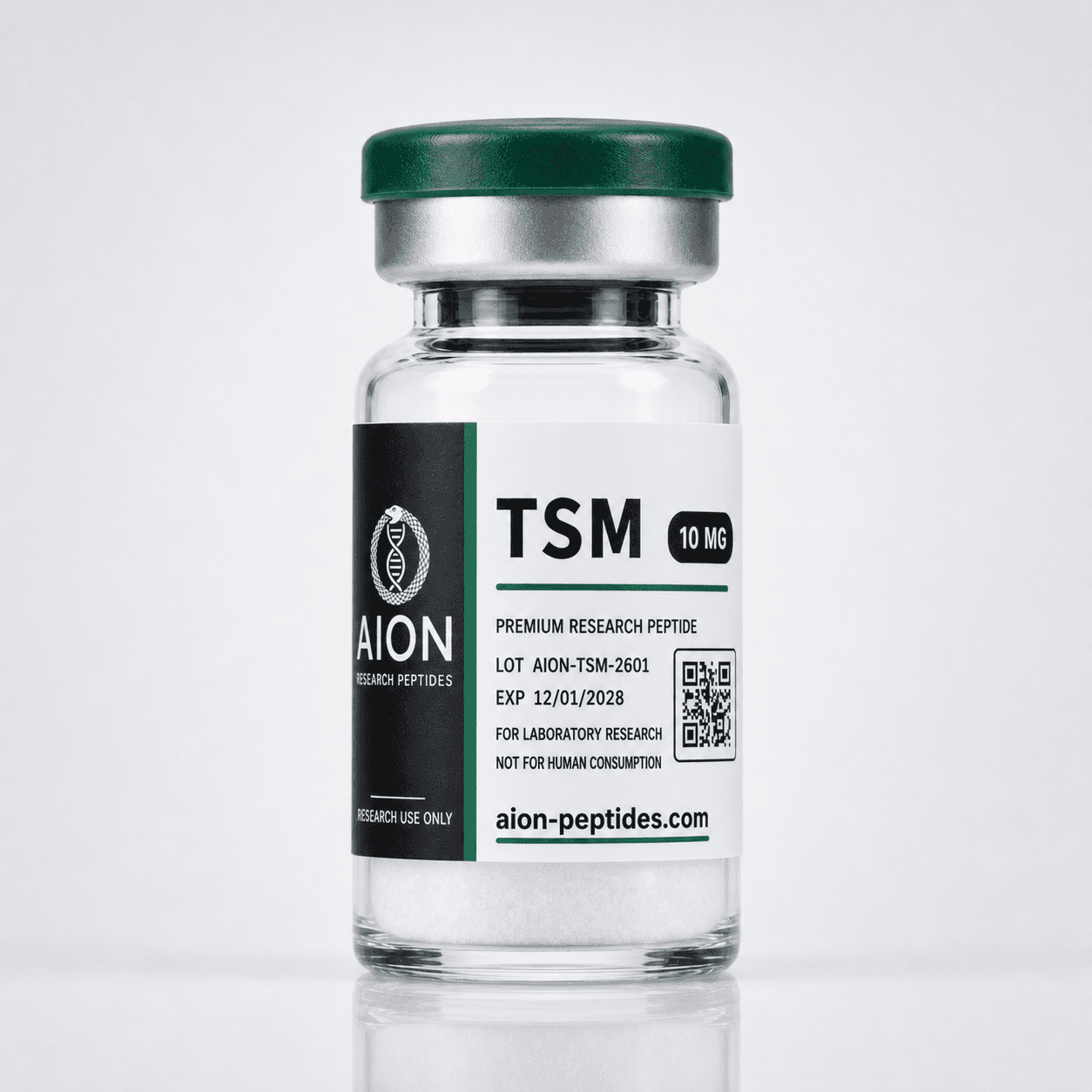
Thymosin Alpha-1 10mg
Thymosin alpha-1 is a 28-amino-acid peptide originally isolated from thymosin fraction 5, a thymic tissue extract. It is among the most studied immunomodulatory peptides, appearing in research on T-cell maturation and innate immune signalling. Supplied lyophilised. For laboratory research use only.
$124.99
About Thymosin Alpha-1 in research
Thymosin alpha-1 (thymalfasin) is a 28-residue N-acetylated thymic peptide studied in T-cell and dendritic-cell work, mouse models and clinical trials. It was first characterised in 1977, when Goldstein and colleagues determined the sequence of a polypeptide isolated from calf thymus. They described it as a heat-stable, highly acidic molecule of 28 amino acids, one of several polypeptides in thymosin fraction 5, a thymic tissue extract, and proposed that it may take part in the regulation, differentiation and function of thymus-dependent lymphocytes. The same paper suggested a nomenclature for the family of polypeptides in fraction 5. Later research has used a synthetic peptide made to the same sequence.
One line of work concerns T-cell development. Knutsen and colleagues cocultured human CD34+ stem cells with allogeneic cultured thymic epithelial fragments for one to four weeks and followed T-cell maturation by flow cytometry. Thymosin alpha-1 increased the number of mononuclear cells recovered from the cocultures at two and four weeks and increased CD3+ cells at three and four weeks. The subpopulation that rose most was single-positive CD4+ cells, which laser confocal immunofluorescence microscopy placed within the thymic tissue fragments. The authors also observed a trend towards higher synthesis of IL-7, a cytokine involved in thymocyte maturation.
A second line concerns innate immune signalling. Romani and colleagues reported that thymosin alpha-1 induced functional maturation and interleukin-12 production in dendritic cells pulsed with the fungus Aspergillus fumigatus. The effect ran through the p38 MAPK and NF-κB pathway and depended on MyD88, involving distinct Toll-like receptors. In mice that had received haematopoietic transplants, a group highly susceptible to aspergillosis, the synthetic peptide was associated with T-helper 1-dependent antifungal immunity, faster myeloid cell recovery and protection from infection. The authors proposed that the peptide acts on both innate and adaptive arms of the response to the fungus, through the dendritic cell.
The peptide has also been studied in human clinical trials, and a 2009 review by Goldstein describes it as approved in a number of countries. In a randomised controlled trial of 98 patients with chronic hepatitis B, Chien and colleagues reported higher rates of combined clearance of viral DNA and HBeAg 18 months after entry in the treated groups than in untreated controls, although rates were similar when first assessed at the end of treatment. In a multicentre randomised trial of 361 patients with severe sepsis, Wu and colleagues reported 28-day all-cause mortality of 26.0% with the peptide and 35.0% in controls, a difference of marginal statistical significance, alongside a greater rise in monocyte HLA-DR expression.
The mechanistic evidence is preclinical. The T-cell maturation and Toll-like receptor findings come from cell culture and mouse models, and the clinical trials measured outcomes in specific patient groups rather than establishing how the peptide works. The pathways listed below are therefore proposals drawn from individual models rather than a settled account.
- Signalling through MyD88-dependent Toll-like receptor pathways, reported in fungus-pulsed dendritic cells in vitro.
- p38 MAPK and NF-κB activation leading to dendritic-cell maturation and interleukin-12 production, reported in dendritic cells pulsed with Aspergillus fumigatus.
- Promotion of CD34+ stem-cell maturation into CD3+CD4+ T cells, reported in a human thymic epithelial organ coculture model.
- Increased IL-7 synthesis, proposed from a trend observed in the same thymic coculture model.
- T-helper 1-dependent antifungal immunity with faster myeloid cell recovery, reported in mice after haematopoietic transplantation.
- Goldstein AL, Low TL, et al. (1977). Thymosin alpha1: isolation and sequence analysis of an immunologically active thymic polypeptide. Proc Natl Acad Sci U S A. [IN VITRO] PubMed record for reference 1, Goldstein 1977
- Knutsen AP, Freeman JJ, et al. (1999). Thymosin-alpha1 stimulates maturation of CD34+ stem cells into CD3+4+ cells in an in vitro thymic epithelia organ coculture model. Int J Immunopharmacol. [IN VITRO] PubMed record for reference 2, Knutsen 1999
- Romani L, Bistoni F, et al. (2004). Thymosin alpha 1 activates dendritic cells for antifungal Th1 resistance through toll-like receptor signaling. Blood. [RODENT] PubMed record for reference 3, Romani 2004
- Chien RN, Liaw YF, et al. (1998). Efficacy of thymosin alpha1 in patients with chronic hepatitis B: a randomized, controlled trial. Hepatology. [HUMAN CLINICAL] PubMed record for reference 4, Chien 1998
- Wu J, Zhou L, et al. (2013). The efficacy of thymosin alpha 1 for severe sepsis (ETASS): a multicenter, single-blind, randomized and controlled trial. Crit Care. [HUMAN CLINICAL] PubMed record for reference 5, Wu 2013
- Goldstein AL (2009). From lab to bedside: emerging clinical applications of thymosin alpha 1. Expert Opin Biol Ther. [REVIEW] PubMed record for reference 6, Goldstein 2009
Identity
- SEQUENCE
- Ac-SDAAVDTSSEITTKDLKEKKEVVEEAEN-OH (Ac-Ser-Asp-Ala-Ala-Val-Asp-Thr-Ser-Ser-Glu-Ile-Thr-Thr-Lys-Asp-Leu-Lys-Glu-Lys-Lys-Glu-Val-Val-Glu-Glu-Ala-Glu-Asn-OH)
- MOLECULAR FORMULA
- C129H215N33O55
- MOLECULAR WEIGHT
- 3108.3 g/mol
- CAS NUMBER
- 62304-98-7
- PUBCHEM CID
- 16130571
Formula, weight, CAS and sequence from PubChem (CID 16130571), with the formula recomputed from the sequence; no certificate of analysis has been published for this product yet.
Storage and handling
- Keep the lyophilised powder sealed, dry and protected from light, typically at -20 °C for long-term storage. Allow the vial to reach room temperature before opening to limit moisture uptake.
- Once in solution, keep at 2–8 °C and use promptly. For longer storage, solutions are typically divided into aliquots and frozen at -20 °C or below, avoiding repeated freeze-thaw. Solution stability has not been established for this lot.
- Generally soluble in sterile water and common aqueous buffers. Add the solvent slowly down the side of the vial and swirl gently rather than shaking.
- Adding 2 mL of sterile water to a 10 mg vial gives a 5 mg/mL stock solution.
Lab testing
Certificate of Analysis
No certificate of analysis is published for this product yet. Where a certificate exists we publish it in full, as issued by the laboratory — the measured purity, the lot number and the date of analysis, not a summary written by us.
Certificates are being obtained for the remainder of the catalogue.
Questions
What is the amino acid sequence of thymosin alpha-1?
Ac-SDAAVDTSSEITTKDLKEKKEVVEEAEN-OH: twenty-eight residues with an acetylated N-terminal serine and a free C-terminal asparagine. PubChem (CID 16130571, listed as thymalfasin) gives the formula C129H215N33O55 and a molecular weight of 3108.3 g/mol, and lists CAS 62304-98-7.
How does thymosin alpha-1 relate to thymosin fraction 5 and the other thymosins?
Thymosin fraction 5 is an extract of thymic tissue containing several polypeptides. Thymosin alpha-1 is one of them, sequenced from calf thymus in 1977, and the same paper proposed the naming scheme for the family. The name thymosin therefore covers several distinct polypeptides with different sequences, and the studies on this page concern the 28-residue alpha-1 peptide, made synthetically.
How should thymosin alpha-1 be stored in the lab?
As lyophilised powder, sealed, dry and away from light, typically at -20 °C for long-term storage. Once in solution, keep it at 2–8 °C and use it promptly, or freeze aliquots to avoid repeated freeze-thaw.
Is there a certificate of analysis for this product?
Not yet. A certificate of analysis has not been published for this product, and the COA library at /coa lists Thymosin Alpha-1 as in progress. The certificate panel on this page will show the laboratory, tests and figures once a certificate is on file.
In which research models has thymosin alpha-1 been studied?
Cell work includes human CD34+ stem cells cocultured with thymic epithelial fragments and dendritic cells pulsed with Aspergillus fumigatus. Animal work includes mice given haematopoietic transplants. It has also been studied in randomised clinical trials in chronic hepatitis B and severe sepsis.
REVIEWED BY DEL POTTER, PHD · OCT 26, 2026
FOR LABORATORY RESEARCH USE ONLY · NOT FOR HUMAN OR ANIMAL USE · MUST BE 21+