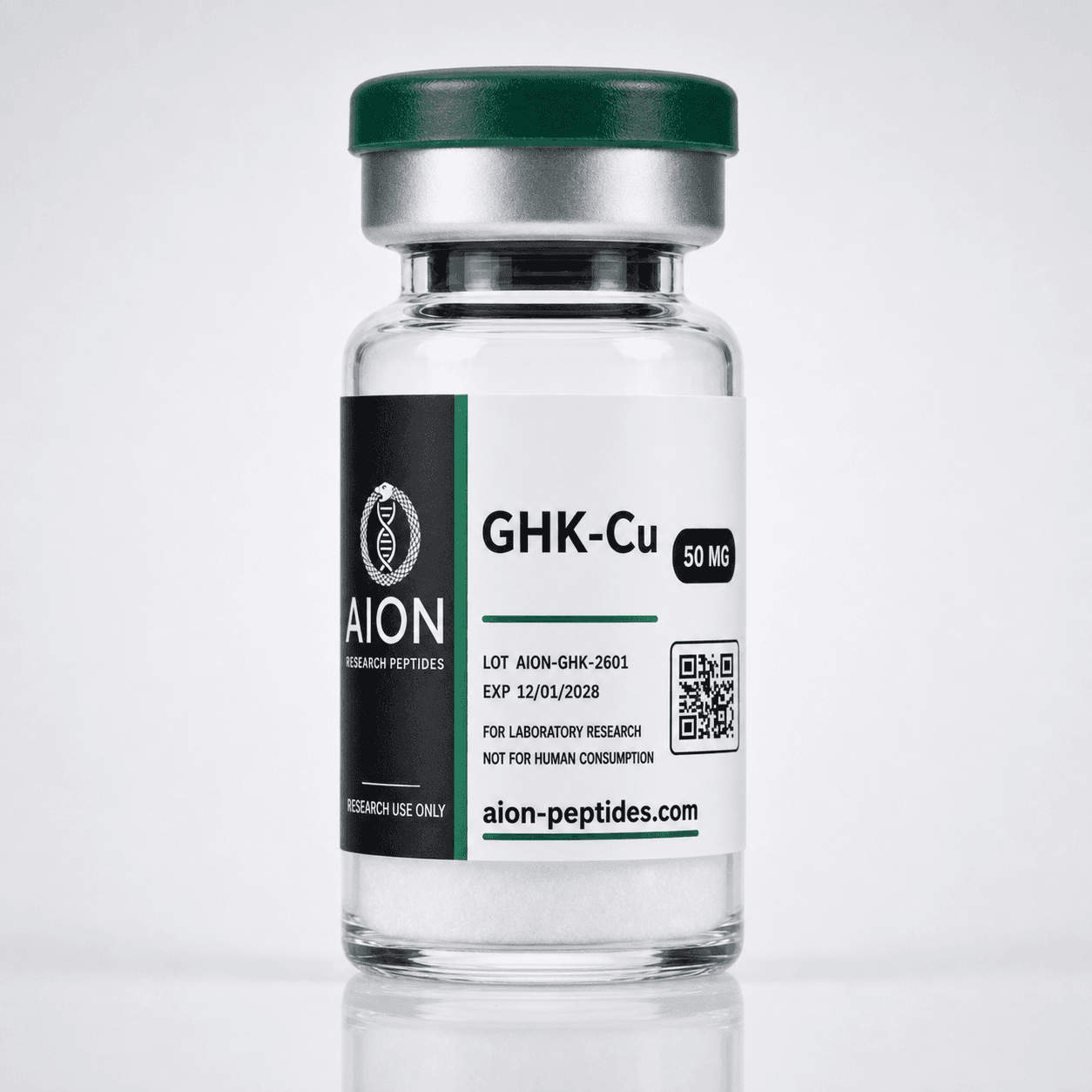
GHK-Cu 50mg
GHK-Cu is the tripeptide glycyl-L-histidyl-L-lysine complexed with copper(II). The GHK sequence occurs naturally in human plasma, where its concentration declines with age, and it binds copper with high affinity — the property that makes it a subject of extracellular-matrix and collagen-remodelling research. It appears widely in dermatological and wound-model studies. Supplied lyophilised as the copper complex, which gives it a characteristic blue colour. Independently assayed by a third-party laboratory, named on this page; the certificate of analysis for this lot, with its measured purity and batch number, is published on this page. For laboratory research use only.
$70.00
About GHK-Cu in research
GHK-Cu is the copper(II) complex of the tripeptide glycyl-L-histidyl-L-lysine, studied in cell-culture and rodent models of extracellular-matrix remodelling. The free tripeptide, GHK, was first described as a constituent of human plasma, and it binds copper(II) with high affinity. Equilibrium studies found that GHK can compete with albumin for copper(II) at physiological pH, which led to the proposal that the complex takes part in copper transport from blood to tissues.
Much of the early laboratory work on GHK-Cu comes from fibroblast cultures. In one in vitro study, GHK-Cu stimulated collagen synthesis by fibroblasts at concentrations from roughly 10^-12 to 10^-11 M, with a maximum near 10^-9 M, and the effect did not depend on any change in cell number. The authors noted that the GHK sequence occurs within the alpha 2(I) chain of type I collagen, and suggested that the tripeptide could be released by proteases at sites of tissue damage. A related study in dermal fibroblast cultures found that GHK-Cu raised MMP-2 levels and MMP-2 mRNA, along with secretion of the inhibitors TIMP-1 and TIMP-2. Copper ions alone reproduced the MMP-2 effect, while GHK alone did not.
In a rat experimental wound-chamber model, GHK-Cu was associated with increased wound-tissue production, type I collagen and glycosaminoglycan content. It also shifted the expression of two small proteoglycans, raising decorin mRNA and lowering biglycan mRNA. Decorin expression was also increased in rat dermal fibroblast cultures. The authors concluded that the complex modulates different extracellular-matrix components in different ways during tissue repair in this model.
Work outside the matrix literature includes a mouse model of lipopolysaccharide-induced acute lung injury, combined with LPS-stimulated RAW 264.7 macrophages in vitro. In that study GHK-Cu was reported to reduce reactive oxygen species and TNF-alpha and IL-6 production, to increase superoxide dismutase activity, and to suppress NF-kappaB p65 and p38 MAPK signalling, with less inflammatory-cell infiltration into lung tissue. A review also discusses gene-expression data suggesting that GHK is associated with changes across many biochemical pathways. Its authors are affiliated with a company working on GHK, and those interpretations rest largely on cell-culture and animal work.
Taken together, the evidence for GHK-Cu is preclinical: it comes from in vitro chemistry, cell cultures and rodent models, and it should be read in those terms. This material is supplied lyophilised as the copper complex, which accounts for its blue colour, and it is intended for laboratory research only.
- High-affinity binding of copper(II) by GHK, with the lysine epsilon-amino group reported to raise complex stability; proposed as a route for copper transport from plasma to tissues (in vitro equilibrium studies).
- Stimulation of collagen synthesis, reported in fibroblast cultures at nanomolar and lower concentrations.
- Modulation of matrix turnover through increased MMP-2, TIMP-1 and TIMP-2, reported in dermal fibroblast cultures.
- Regulation of glycosaminoglycan and proteoglycan expression (raised decorin, lowered biglycan), reported in a rat wound-chamber model.
- Suppression of NF-kappaB p65 and p38 MAPK signalling with lower TNF-alpha and IL-6, reported in LPS-stimulated macrophages and a mouse lung-injury model.
- Lau SJ, Sarkar B (1981). The interaction of copper(II) and glycyl-L-histidyl-L-lysine, a growth-modulating tripeptide from plasma. Biochem J. [IN VITRO] PubMed record for reference 1, Lau 1981
- Maquart FX, Pickart L, Laurent M, et al. (1988). Stimulation of collagen synthesis in fibroblast cultures by the tripeptide-copper complex glycyl-L-histidyl-L-lysine-Cu2+. FEBS Lett. [IN VITRO] PubMed record for reference 2, Maquart 1988
- Siméon A, Emonard H, Hornebeck W, et al. (2000). The tripeptide-copper complex glycyl-L-histidyl-L-lysine-Cu2+ stimulates matrix metalloproteinase-2 expression by fibroblast cultures. Life Sci. [IN VITRO] PubMed record for reference 3, Siméon 2000
- Siméon A, Wegrowski Y, Bontemps Y, et al. (2000). Expression of glycosaminoglycans and small proteoglycans in wounds: modulation by the tripeptide-copper complex glycyl-L-histidyl-L-lysine-Cu(2+). J Invest Dermatol. [RODENT] PubMed record for reference 4, Siméon 2000
- Park JR, Lee H, Kim SI, et al. (2016). The tri-peptide GHK-Cu complex ameliorates lipopolysaccharide-induced acute lung injury in mice. Oncotarget. [RODENT] PubMed record for reference 5, Park 2016
- Pickart L, Margolina A (2018). Regenerative and Protective Actions of the GHK-Cu Peptide in the Light of the New Gene Data. Int J Mol Sci. [REVIEW] PubMed record for reference 6, Pickart 2018
Identity
- SEQUENCE
- Gly-His-Lys (GHK), as its copper(II) complex
- MOLECULAR FORMULA
- C14H22CuN6O4
- MOLECULAR WEIGHT
- 401.91 g/mol
- CAS NUMBER
- 89030-95-5
- PUBCHEM CID
- 165429100
Formula and molecular weight of the neutral copper complex from PubChem (CID 165429100), matching the certificate of analysis for lot ABL-GHK-2601; CAS number as PubChem lists it for prezatide copper (CID 71587328).
Storage and handling
- Store the lyophilised powder sealed at -20 °C for long-term storage, protected from light and moisture. Allow the vial to reach room temperature before opening to limit condensation.
- Store solutions at 2–8 °C, protected from light, and prepare them fresh where possible. For longer storage, divide into aliquots and freeze at -20 °C, avoiding repeated freeze-thaw.
- Soluble in water, giving a clear blue solution; the colour comes from the copper(II) complex. Sterile water or a neutral aqueous buffer is the usual laboratory solvent.
- Adding 5 mL of sterile water to a 50 mg vial gives a 10 mg/mL stock solution.
Lab testing
Certificate of Analysis
THIRD-PARTY VERIFIED
Purity
99.74%
Lot
ABL-GHK-2601
Formula
C14H22CuN6O4
Certificate date
Jun 18, 2026
Laboratory
Freedom Diagnostics
TESTS REPORTED Purity (HPLC-UV) · Identity by mass (LC-MS)
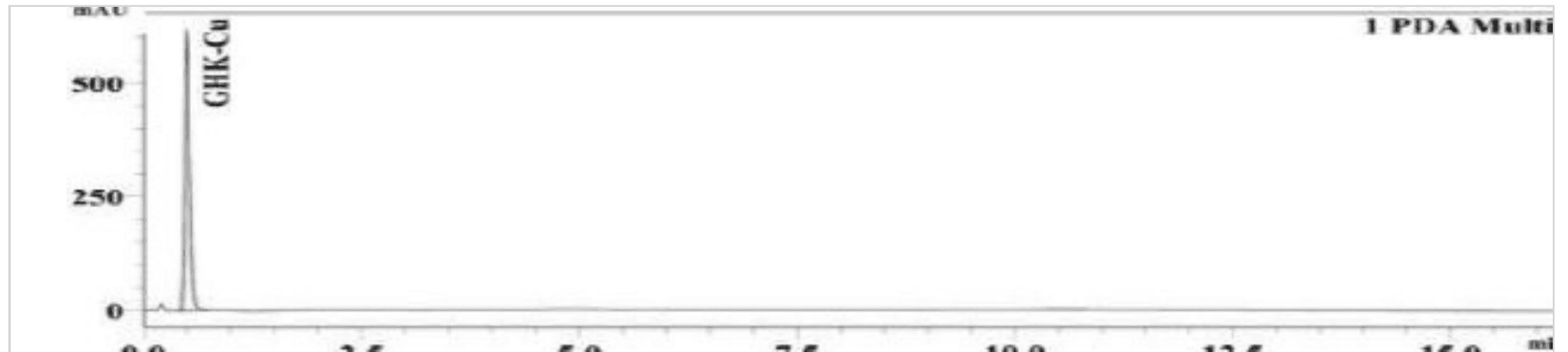
Lab report issued by Freedom Diagnostics for the sourced batch. For laboratory research use only.
Questions
What is the difference between GHK and GHK-Cu?
GHK is the free tripeptide glycyl-L-histidyl-L-lysine. GHK-Cu is that tripeptide bound to a copper(II) ion. They have separate PubChem records and CAS numbers, and they are not interchangeable in the literature: in one fibroblast study, copper ions reproduced the MMP-2 effect of GHK-Cu while GHK alone did not. This product is the copper complex.
Why is GHK-Cu blue?
The colour comes from the copper(II) ion. Copper(II)–GHK complexes absorb in the visible range, and their absorption spectra have been characterised in solution chemistry studies. The free peptide is not blue, so the colour is a quick visual check that the material is the copper complex.
Which CAS number and PubChem entry describe this material?
The copper complex is CAS 89030-95-5, PubChem CID 71587328. PubChem draws it as a singly charged complex, C14H23CuN6O4+, while the certificate for this lot gives the neutral formula C14H22CuN6O4. Both describe the 1:1 copper complex of GHK. The free peptide GHK has a different CAS number (49557-75-7) and PubChem record (CID 73587).
What does the certificate of analysis test?
The certificate for this lot, issued by a named third-party laboratory, reports purity by HPLC-UV and identity by mass using LC-MS. The measured purity, lot number and the chromatogram as printed on the certificate are shown on this page.
In which research models has GHK-Cu been studied?
Published work includes copper-binding chemistry in solution, fibroblast cultures (collagen synthesis and MMP-2 expression), a rat wound-chamber model, and a mouse model of lipopolysaccharide-induced lung injury with cultured macrophages. The evidence is preclinical.
REVIEWED BY DEL POTTER, PHD · OCT 26, 2026
FOR LABORATORY RESEARCH USE ONLY · NOT FOR HUMAN OR ANIMAL USE · MUST BE 21+