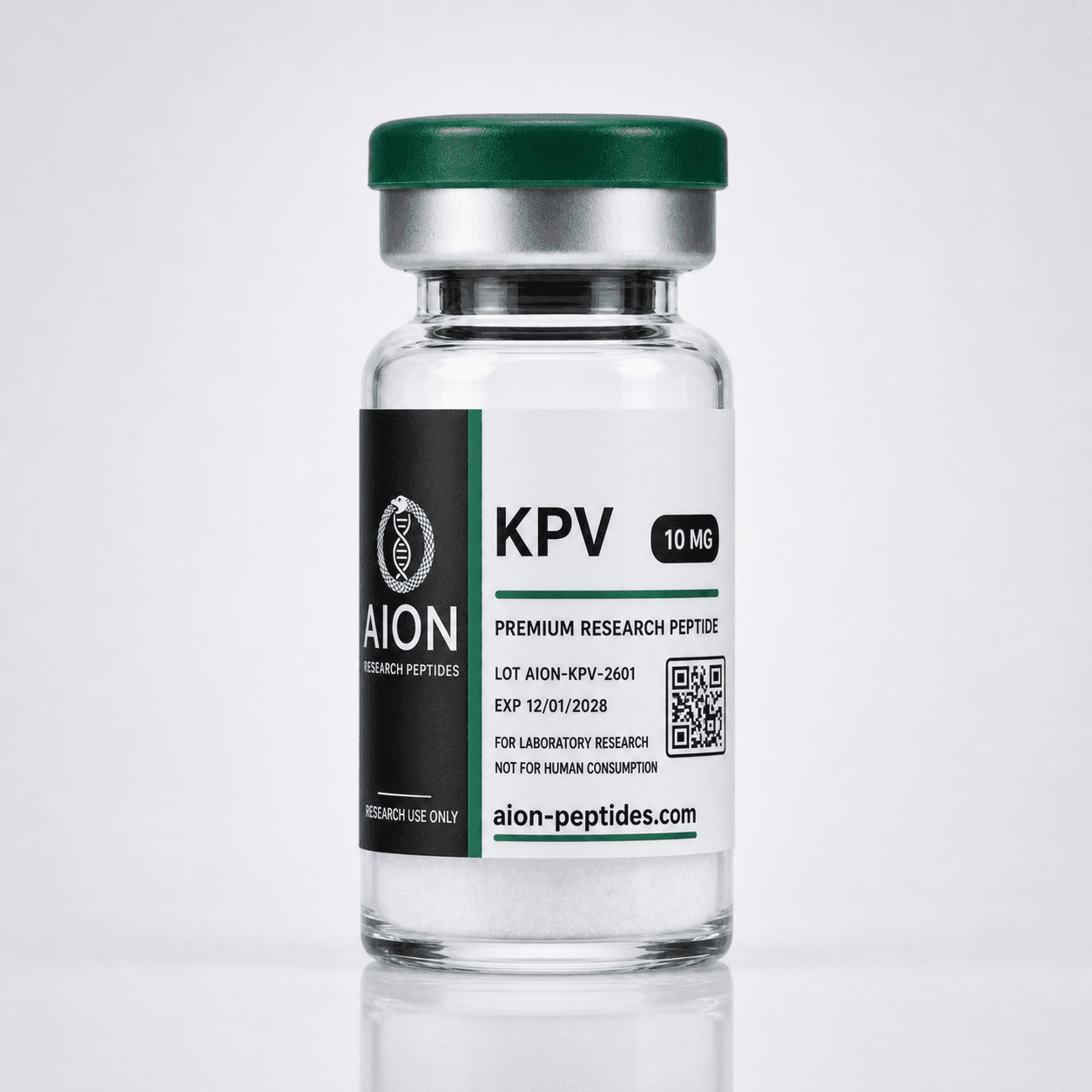
KPV - 10mg
KPV is the tripeptide lysyl-prolyl-valine, corresponding to the C-terminal three residues of α-melanocyte-stimulating hormone. It retains the anti-inflammatory activity associated with the parent hormone in the literature while lacking its pigmentary domain, and appears in gastrointestinal and dermatological inflammation research. Supplied lyophilised. For laboratory research use only.
$64.99
About KPV in research
KPV is the tripeptide Lys-Pro-Val, the C-terminal end of alpha-MSH, studied in intestinal epithelial cells and mouse colitis models. Alpha-melanocyte-stimulating hormone (alpha-MSH) is a 13-residue peptide derived from proopiomelanocortin, and KPV corresponds to its residues 11-13. A 2008 review by Brzoska and colleagues describes how interest in the tripeptide arose: it retained anti-inflammatory activity in experimental systems while lacking the pigmentary action of the full hormone.
Early cell work compared the tripeptide with the parent hormone. In RAW 264.7 macrophage-like cells stimulated with lipopolysaccharide and interferon-gamma, Mandrika and colleagues reported that alpha-MSH(11-13) inhibited nitric oxide production and nuclear translocation of NF-kappaB, with maximal effects in the nanomolar to micromolar range. Unlike alpha-MSH, the tripeptide did not compete for melanocortin-1 receptor binding and did not raise cAMP in these cells, which led the authors to propose a receptor-independent route for its effect on NF-kappaB.
Much of the later work concerns the intestine. Dalmasso and colleagues at Emory University studied human intestinal epithelial cell lines (Caco2-BBE and HT29-Cl.19A) and Jurkat T cells stimulated with pro-inflammatory cytokines. Nanomolar KPV reduced NF-kappaB and MAP kinase signalling and pro-inflammatory cytokine secretion, and uptake studies with radiolabelled KPV indicated that it enters these cells through PepT1, a di- and tripeptide transporter that the authors describe as normally expressed in the small intestine and induced in the colon in inflammatory bowel disease. In the same paper, KPV given in drinking water reduced inflammation in DSS- and TNBS-induced colitis in mice. Kannengiesser and colleagues in Münster reported reduced inflammatory infiltrates and colonic myeloperoxidase activity, and faster recovery of body weight, in KPV-treated mice with DSS colitis and with CD45RB-high T-cell transfer colitis. Mice with a non-functional melanocortin-1 receptor also responded, suggesting the effect is at least partly independent of that receptor.
A further strand uses KPV as a test cargo for colon-targeted delivery. Laroui and colleagues loaded the tripeptide into polymeric nanoparticles of about 400 nm, encapsulated in an alginate-chitosan hydrogel that released them in the mouse colon; the loaded particles reduced lipopolysaccharide-induced responses in Caco2-BBE cells and reduced inflammatory and histological markers in DSS colitis at a far lower KPV concentration than free peptide. Xiao and colleagues later used hyaluronic acid-functionalised nanoparticles to target colonic epithelial cells and macrophages, and reported less mucosal damage and lower TNF-alpha in a mouse colitis model than with non-targeted particles.
The evidence base is preclinical. The studies cited here were carried out in cultured cell lines and in chemically or immunologically induced colitis in mice, mostly by a small number of research groups, and the proposed mechanisms below come from those individual models rather than a settled account.
- Uptake into intestinal epithelial and T cells through the PepT1 di/tripeptide transporter, reported in human cell lines.
- Inhibition of NF-kappaB activation and MAP kinase signalling, reported in cytokine-stimulated intestinal epithelial cells and LPS-stimulated macrophage-like cells.
- Reduced pro-inflammatory cytokine expression and colonic myeloperoxidase activity, reported in DSS, TNBS and T-cell transfer colitis in mice.
- Action at least partly independent of the melanocortin-1 receptor and cAMP, proposed from receptor-binding studies in RAW 264.7 cells and from mice lacking a functional MC1R.
- Dalmasso G, Charrier-Hisamuddin L, Nguyen HT, et al. (2008). PepT1-mediated tripeptide KPV uptake reduces intestinal inflammation. Gastroenterology. [RODENT] PubMed record for reference 1, Dalmasso 2008
- Kannengiesser K, Maaser C, Heidemann J, et al. (2008). Melanocortin-derived tripeptide KPV has anti-inflammatory potential in murine models of inflammatory bowel disease. Inflamm Bowel Dis. [RODENT] PubMed record for reference 2, Kannengiesser 2008
- Mandrika I, Muceniece R, Wikberg JE (2001). Effects of melanocortin peptides on lipopolysaccharide/interferon-gamma-induced NF-kappaB DNA binding and nitric oxide production in macrophage-like RAW 264.7 cells: evidence for dual mechanisms of action. Biochem Pharmacol. [IN VITRO] PubMed record for reference 3, Mandrika 2001
- Laroui H, Dalmasso G, Nguyen HT, et al. (2010). Drug-loaded nanoparticles targeted to the colon with polysaccharide hydrogel reduce colitis in a mouse model. Gastroenterology. [RODENT] PubMed record for reference 4, Laroui 2010
- Xiao B, Xu Z, Viennois E, et al. (2017). Orally Targeted Delivery of Tripeptide KPV via Hyaluronic Acid-Functionalized Nanoparticles Efficiently Alleviates Ulcerative Colitis. Mol Ther. [RODENT] PubMed record for reference 5, Xiao 2017
- Brzoska T, Luger TA, Maaser C, et al. (2008). Alpha-melanocyte-stimulating hormone and related tripeptides: biochemistry, antiinflammatory and protective effects in vitro and in vivo, and future perspectives for the treatment of immune-mediated inflammatory diseases. Endocr Rev. [REVIEW] PubMed record for reference 6, Brzoska 2008
Identity
- SEQUENCE
- KPV (Lys-Pro-Val, L-lysyl-L-prolyl-L-valine)
- MOLECULAR FORMULA
- C16H30N4O4
- MOLECULAR WEIGHT
- 342.43 g/mol
- CAS NUMBER
- 67727-97-3
- PUBCHEM CID
- 125672
Formula and weight from PubChem (CID 125672, alpha-MSH 11-13); CAS from PubChem's ChemIDplus record and the certificate of analysis, lot 20250518.
Storage and handling
- Keep the lyophilised powder sealed, dry and protected from light, typically at -20 °C for long-term storage. Allow the vial to reach room temperature before opening to limit moisture uptake.
- Once in solution, keep at 2–8 °C and use promptly. For longer storage, solutions are typically divided into aliquots and frozen at -20 °C or below, avoiding repeated freeze-thaw. Solution stability has not been established for this lot.
- The certificate reports the lot fully soluble in deionised water and normal saline, giving a clear solution. Add the solvent slowly down the side of the vial and swirl gently rather than shaking.
- Adding 2 mL of sterile water to a 10 mg vial gives a 5 mg/mL stock solution.
Lab testing
Certificate of Analysis
THIRD-PARTY VERIFIED
Purity
99.87%
Lot
20250518
Certificate date
Jun 26, 2026
Laboratory
North South Precision Testing
TESTS REPORTED Purity · Impurities · Heavy metals (Pb, Cd, Hg, As) · Moisture, pH, solubility
Download Certificate of Analysis (PDF)Lab report issued by North South Precision Testing for the sourced batch. For laboratory research use only.
Questions
What is the sequence of KPV?
Lys-Pro-Val (L-lysyl-L-prolyl-L-valine), three residues. PubChem (CID 125672) gives the formula C16H30N4O4 and a molecular weight of 342.43 g/mol, and lists CAS 67727-97-3 for the free peptide.
How does KPV differ from alpha-MSH?
Alpha-MSH is a 13-residue peptide derived from proopiomelanocortin; KPV is its C-terminal residues 11-13. In RAW 264.7 cells the tripeptide inhibited NF-kappaB translocation as alpha-MSH did, but it did not bind the melanocortin-1 receptor or raise cAMP, and reviews describe it as lacking the pigmentary action of the full hormone.
How should KPV be stored in the lab?
As lyophilised powder, sealed, dry and away from light, typically at -20 °C for long-term storage. Once in solution, keep it at 2–8 °C and use it promptly, or freeze aliquots to avoid repeated freeze-thaw.
What does the certificate of analysis test?
The certificate for this lot, issued by North South Precision Testing, reports appearance, purity, impurities, moisture content, pH, solubility, residual solvents and heavy metals (Pb, Cd, Hg, As). The measured purity and lot number are shown in the certificate panel on this page.
In which research models has KPV been studied?
Human intestinal epithelial cell lines (Caco2-BBE, HT29-Cl.19A), Jurkat T cells and RAW 264.7 macrophage-like cells in vitro, and DSS, TNBS and T-cell transfer colitis in mice, including studies that deliver it in nanoparticles targeted to the colon.
REVIEWED BY DEL POTTER, PHD · OCT 26, 2026
FOR LABORATORY RESEARCH USE ONLY · NOT FOR HUMAN OR ANIMAL USE · MUST BE 21+