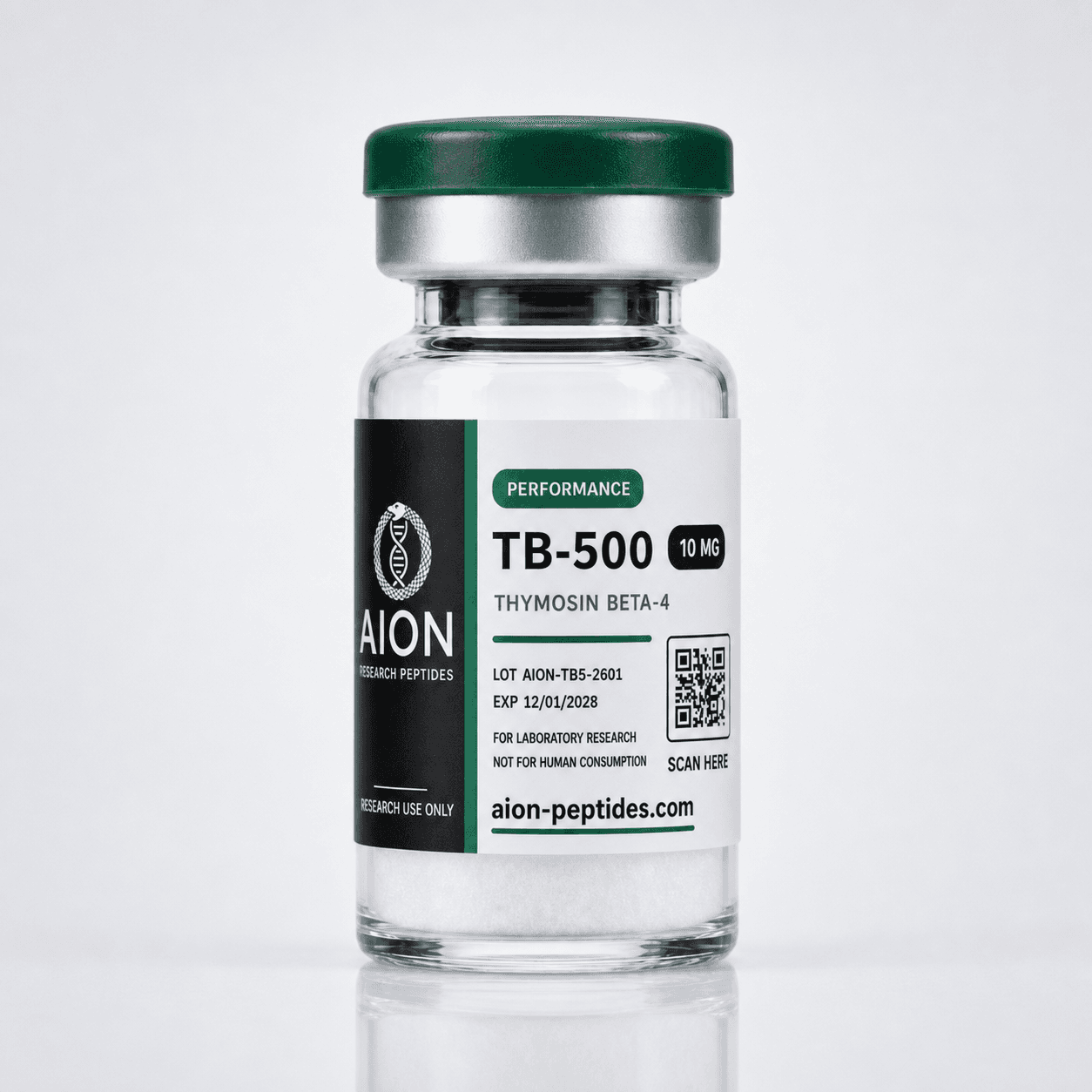
TB-500 10mg
TB-500 is a synthetic peptide corresponding to the active region of thymosin β4 — the short actin-binding sequence around residues 17–23, rather than the full 43-residue protein. Actin sequestration is the mechanism most cited in the cell-migration and tissue-repair literature in which it appears. Supplied lyophilised. Independently assayed by a third-party laboratory, named on this page; the certificate of analysis for this lot, with its measured purity and batch number, is published on this page. For laboratory research use only.
$100.00
About TB-500 in research
TB-500 is a research name linked to thymosin beta-4, a 43-residue actin-sequestering peptide, and to its seven-residue actin-binding region, LKKTETQ. The name is used for two different molecules. In the analytical literature, TB-500 denotes a synthetic copy of residues 17–23 of thymosin beta-4 with an acetylated N-terminus (Ac-LKKTETQ), a peptide of roughly 889 g/mol. Full-length thymosin beta-4 is far larger, at about 4963 g/mol. The certificate of analysis for this lot lists the CAS number, formula and molecular weight of full-length thymosin beta-4, so the identity table on this page gives those figures.
Most of the published research concerns full-length thymosin beta-4, not the seven-residue fragment, and the findings below are attributed to the molecule each study used. Thymosin beta-4 was shown to be identical to Fx, the peptide that holds much of the unpolymerized actin in human platelets. In purified-protein experiments it formed a 1:1 complex with actin monomers and inhibited their polymerization, which is why it is described as an actin-sequestering peptide.
In a rat full-thickness wound model, full-length thymosin beta-4 increased re-epithelialization, wound contraction, collagen deposition and angiogenesis compared with saline controls, and it stimulated keratinocyte migration in a Boyden chamber assay. A later study in db/db diabetic mice and in aged mice reported increased wound contraction and collagen deposition with thymosin beta-4. The same study is one of the few to test the fragment directly: a synthetic peptide with the sequence LKKTETQ promoted repair in the aged mice comparably to the parent molecule.
In cardiac research, thymosin beta-4 promoted the migration of myocardial and endothelial cells in the embryonic mouse heart and supported the survival of embryonic and postnatal cardiomyocytes in culture. The authors reported that it formed a complex with PINCH and integrin-linked kinase (ILK), leading to activation of the survival kinase Akt. After coronary artery ligation in mice, thymosin beta-4 was associated with higher ILK and Akt activity, improved early myocyte survival and improved cardiac function. A review by researchers in the field summarizes further reported activities of thymosin beta-4 in skin, eye, heart and brain models, including effects on cell migration, apoptosis, inflammation and myofibroblast numbers in wounds.
The evidence summarized here is preclinical, from cell, purified-protein and animal models. Published work on Ac-LKKTETQ itself is limited; one study developed a liquid chromatography–mass spectrometry method to detect it and its metabolites in equine urine and plasma, which is an analytical study rather than a test of biological activity. Findings for full-length thymosin beta-4 should not be assumed to apply to the fragment, or the reverse. This material is supplied for laboratory research only.
- G-actin sequestration: thymosin beta-4 binds actin monomers in a 1:1 complex and inhibits their polymerization, reported in purified-protein experiments.
- Cell migration: thymosin beta-4 is reported to stimulate keratinocyte migration in vitro and myocardial and endothelial cell migration in the embryonic mouse heart.
- ILK–Akt signalling: thymosin beta-4 is proposed to form a complex with PINCH and integrin-linked kinase, activating Akt, as reported in mouse cardiomyocytes and a mouse coronary ligation model.
- Angiogenesis and matrix deposition: increased angiogenesis and collagen deposition were reported with thymosin beta-4 in a rat full-thickness wound model.
- Actin-binding domain: residues 17–23 (LKKTETQ) are proposed as the region responsible for actin binding, and a synthetic LKKTETQ peptide was reported to promote dermal repair in aged mice.
- Safer D, Elzinga M, Nachmias VT (1991). Thymosin beta 4 and Fx, an actin-sequestering peptide, are indistinguishable. J Biol Chem. [IN VITRO] PubMed record for reference 1, Safer 1991
- Malinda KM, Sidhu GS, Mani H, et al. (1999). Thymosin beta4 accelerates wound healing. J Invest Dermatol. [RODENT] PubMed record for reference 2, Malinda 1999
- Philp D, Badamchian M, Scheremeta B, et al. (2003). Thymosin beta 4 and a synthetic peptide containing its actin-binding domain promote dermal wound repair in db/db diabetic mice and in aged mice. Wound Repair Regen. [RODENT] PubMed record for reference 3, Philp 2003
- Bock-Marquette I, Saxena A, White MD, et al. (2004). Thymosin beta4 activates integrin-linked kinase and promotes cardiac cell migration, survival and cardiac repair. Nature. [RODENT] PubMed record for reference 4, Bock-Marquette 2004
- Goldstein AL, Hannappel E, Sosne G, et al. (2012). Thymosin β4: a multi-functional regenerative peptide. Basic properties and clinical applications. Expert Opin Biol Ther. [REVIEW] PubMed record for reference 5, Goldstein 2012
- Ho EN, Kwok WH, Lau MY, et al. (2012). Doping control analysis of TB-500, a synthetic version of an active region of thymosin β₄, in equine urine and plasma by liquid chromatography-mass spectrometry. J Chromatogr A. [OTHER ANIMAL] PubMed record for reference 6, Ho 2012
Identity
- SEQUENCE
- Ac-SDKPDMAEIEKFDKSKLKKTETQEKNPLPSKETIEQEKQAGES-OH
- MOLECULAR FORMULA
- C212H350N56O78S
- MOLECULAR WEIGHT
- 4963.44 g/mol
- CAS NUMBER
- 77591-33-4
- PUBCHEM CID
- 16132341
Formula, molecular weight and CAS number from the certificate of analysis for lot ABL-TB5-2602, checked against PubChem's record for full-length thymosin beta-4 (CID 16132341); sequence from PubChem.
Storage and handling
- Store the sealed vial at −20 °C, dry and protected from light. Let it reach room temperature before opening to limit condensation.
- Keep solutions at 2–8 °C and use them promptly. For longer storage, divide into aliquots and freeze at −20 °C or below, avoiding repeated freeze–thaw. Stability in solution has not been established for this lot.
- Thymosin beta-4 is an acidic, hydrophilic peptide and is typically soluble in sterile water or aqueous buffers such as PBS. A solubility limit has not been measured for this lot.
- Adding 2 mL of sterile water to a 10 mg vial gives a 5 mg/mL stock solution. The certificate reports 12.15 mg measured in the tested vial, so concentrations based on the 10 mg label amount are nominal.
Lab testing
Certificate of Analysis
THIRD-PARTY VERIFIED
Purity
99.35%
Lot
ABL-TB5-2602
Formula
C212H350N56O78S
Certificate date
Jun 18, 2026
Laboratory
Freedom Diagnostics
TESTS REPORTED Purity (HPLC-UV) · Identity by mass (LC-MS)
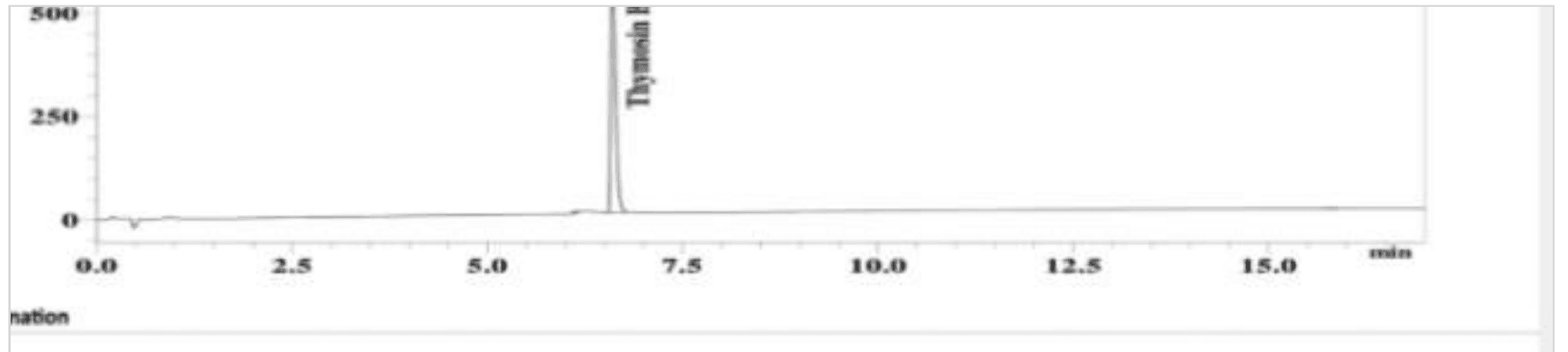
Lab report issued by Freedom Diagnostics for the sourced batch. For laboratory research use only.
Questions
What is the difference between TB-500 and thymosin beta-4?
Thymosin beta-4 is a naturally occurring 43-residue peptide of about 4963 g/mol. In the analytical literature, TB-500 refers to a synthetic, N-acetylated copy of its residues 17–23 (Ac-LKKTETQ), about 889 g/mol. Most published research studied full-length thymosin beta-4; the fragment has been tested far less, for example in one aged-mouse wound study. The certificate for this lot gives the figures for full-length thymosin beta-4.
Which molecule does the certificate for this lot identify?
The certificate for lot ABL-TB5-2602 lists CAS 77591-33-4, formula C212H350N56O78S and a molecular weight of 4963.44 g/mol. These match PubChem's record for full-length thymosin beta-4 (CID 16132341), not the seven-residue Ac-LKKTETQ fragment (PubChem CID 62707662, C38H68N10O14). The certificate does not print an observed mass, so researchers who need to distinguish the two should confirm identity by mass spectrometry.
What does the certificate test?
The certificate from Freedom Diagnostics reports chromatographic purity by HPLC-UV (99.35% for this lot) and identity by mass using LC-MS, with a measured content of 12.15 mg in the tested vial. It does not report sterility, endotoxin or heavy-metal testing.
How should the material be stored?
Lyophilized material is typically stored sealed at −20 °C, dry and away from light. Solutions are kept at 2–8 °C and used promptly, or divided into aliquots and frozen to avoid repeated freeze–thaw. Stability in solution has not been established for this lot.
In which research models has thymosin beta-4 been studied?
Reported work includes purified-protein actin-binding experiments, keratinocyte migration assays, rat full-thickness wound models, diabetic and aged mouse wound models, and mouse cardiomyocyte cultures and coronary ligation models. Published work on the Ac-LKKTETQ fragment is much smaller and includes an analytical study in horses. All of this evidence is preclinical.
REVIEWED BY DEL POTTER, PHD · OCT 26, 2026
FOR LABORATORY RESEARCH USE ONLY · NOT FOR HUMAN OR ANIMAL USE · MUST BE 21+