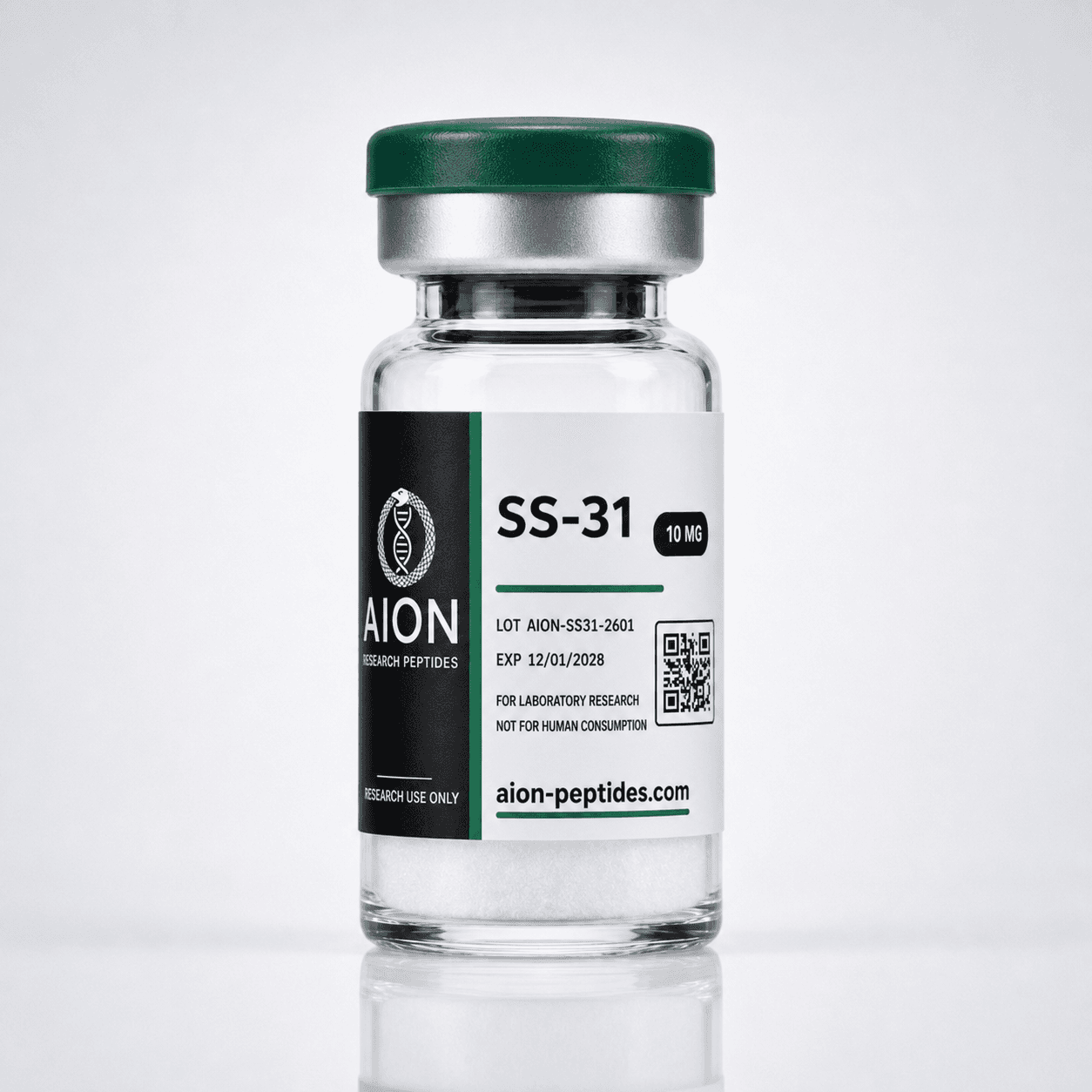
SS-31 10mg
SS-31, also known as elamipretide, is a mitochondria-targeted tetrapeptide that accumulates in the inner mitochondrial membrane and binds cardiolipin. That selectivity is the basis of its use in bioenergetics research concerned with membrane integrity and reactive oxygen species. Supplied lyophilised. For laboratory research use only.
$70.00
About SS-31 in research
SS-31 is a synthetic Szeto-Schiller tetrapeptide that binds cardiolipin in the inner mitochondrial membrane, studied in cell, rodent kidney and heart models. Also known as elamipretide, it has the sequence D-Arg-Dmt-Lys-Phe-NH2, where Dmt is 2',6'-dimethyltyrosine. The Szeto-Schiller peptides were designed around alternating aromatic and basic residues, and the original report describes them as cell-permeable.
The early cell and isolated-organelle work came from Cornell. Zhao and colleagues reported that these peptides concentrate roughly 1000-fold in the inner mitochondrial membrane, reduced intracellular reactive oxygen species and cell death caused by t-butylhydroperoxide in neuronal N2A cells, and inhibited calcium-induced mitochondrial permeability transition, swelling and cytochrome c release in isolated mitochondria. They also improved contractile force in an ex vivo heart reperfusion model. Analogues lacking dimethyltyrosine did not reduce mitochondrial reactive oxygen species or swelling, which the authors took as evidence that the Dmt residue carries the scavenging activity.
Later work from the same group concerned binding partners. Birk and colleagues used a polarity-sensitive fluorescent analogue to report that SS-31 binds cardiolipin with high affinity, and that the SS-31/cardiolipin complex inhibited the peroxidase activity of cytochrome c. In rats subjected to renal ischaemia, pretreatment with SS-31 preserved mitochondrial cristae, prevented mitochondrial swelling and was associated with faster ATP recovery on reperfusion, less tubular apoptosis and less renal dysfunction. A review by Szeto summarises this account: by binding cardiolipin, SS-31 is proposed to keep cytochrome c in its electron-carrier role rather than as a peroxidase, and so to protect cristae structure and oxidative phosphorylation.
Cardiac models form another part of the literature. Dai and colleagues reported that SS-31 prevented angiotensin II-induced mitochondrial reactive oxygen species in neonatal cardiomyocytes, which the non-targeted antioxidant N-acetyl cysteine did not. In mice given angiotensin II for four weeks, SS-31 did not lower blood pressure but attenuated NOX4 up-regulation, mitochondrial protein oxidative damage, p38 MAPK phosphorylation, cardiac hypertrophy, diastolic dysfunction and fibrosis; it also partially rescued the heart failure phenotype of Gαq-overexpressing mice.
Human clinical: in the phase 3 MMPOWER-3 trial in primary mitochondrial myopathy, elamipretide did not meet its primary endpoints of 6-minute walk distance and fatigue score, and in a smaller crossover trial in Barth syndrome neither primary endpoint was met in the double-blind part, with changes reported only in the open-label extension. The US FDA granted elamipretide accelerated approval for Barth syndrome in September 2025 on the basis of knee extensor strength, with a confirmatory trial required. Outside those trials, the mechanistic evidence described here is preclinical, from cultured cells, isolated mitochondria and rodent models.
- Selective binding to cardiolipin on the inner mitochondrial membrane, reported in vitro with a fluorescent SS-31 analogue.
- Inhibition of cytochrome c peroxidase activity by the SS-31/cardiolipin complex, proposed to limit cardiolipin peroxidation and reported in vitro.
- Reduction of mitochondrial reactive oxygen species and inhibition of mitochondrial permeability transition and swelling, reported in neuronal cells and isolated mitochondria.
- Preservation of mitochondrial cristae with faster ATP recovery after ischaemia, reported in a rat renal ischaemia-reperfusion model.
- Attenuation of NOX4 up-regulation and p38 MAPK phosphorylation, reported in an angiotensin II mouse model of cardiac hypertrophy.
- Zhao K, Zhao GM, Wu D, et al. (2004). Cell-permeable peptide antioxidants targeted to inner mitochondrial membrane inhibit mitochondrial swelling, oxidative cell death, and reperfusion injury. J Biol Chem. [IN VITRO] PubMed record for reference 1, Zhao 2004
- Birk AV, Liu S, Soong Y, et al. (2013). The mitochondrial-targeted compound SS-31 re-energizes ischemic mitochondria by interacting with cardiolipin. J Am Soc Nephrol. [RODENT] PubMed record for reference 2, Birk 2013
- Dai DF, Chen T, Szeto H, et al. (2011). Mitochondrial targeted antioxidant Peptide ameliorates hypertensive cardiomyopathy. J Am Coll Cardiol. [RODENT] PubMed record for reference 3, Dai 2011
- Szeto HH (2014). First-in-class cardiolipin-protective compound as a therapeutic agent to restore mitochondrial bioenergetics. Br J Pharmacol. [REVIEW] PubMed record for reference 4, Szeto 2014
- Karaa A, Bertini E, Carelli V, et al. (2023). Efficacy and Safety of Elamipretide in Individuals With Primary Mitochondrial Myopathy: The MMPOWER-3 Randomized Clinical Trial. Neurology. [HUMAN CLINICAL] PubMed record for reference 5, Karaa 2023
- Reid Thompson W, Hornby B, Manuel R, et al. (2021). A phase 2/3 randomized clinical trial followed by an open-label extension to evaluate the effectiveness of elamipretide in Barth syndrome, a genetic disorder of mitochondrial cardiolipin metabolism. Genet Med. [HUMAN CLINICAL] PubMed record for reference 6, Reid 2021
Identity
- SEQUENCE
- D-Arg-Dmt-Lys-Phe-NH2 (D-arginyl-2',6'-dimethyl-L-tyrosyl-L-lysyl-L-phenylalaninamide)
- MOLECULAR FORMULA
- C32H49N9O5
- MOLECULAR WEIGHT
- 639.8 g/mol
- CAS NUMBER
- 736992-21-5
- PUBCHEM CID
- 11764719
Formula, weight and CAS from PubChem (CID 11764719), with the formula recomputed from the sequence; no certificate of analysis has been published for this product yet, so these figures have not been checked against one.
Storage and handling
- Keep the lyophilised powder sealed, dry and protected from light, typically at -20 °C for long-term storage. Allow the vial to reach room temperature before opening to limit moisture uptake.
- Once in solution, keep at 2–8 °C and use promptly. For longer storage, solutions are typically divided into aliquots and frozen at -20 °C or below, avoiding repeated freeze-thaw. Solution stability has not been established for this lot.
- Generally soluble in sterile water and common aqueous buffers. Add the solvent slowly down the side of the vial and swirl gently rather than shaking.
- Adding 2 mL of sterile water to a 10 mg vial gives a 5 mg/mL stock solution.
Lab testing
Certificate of Analysis
No certificate of analysis is published for this product yet. Where a certificate exists we publish it in full, as issued by the laboratory — the measured purity, the lot number and the date of analysis, not a summary written by us.
Certificates are being obtained for the remainder of the catalogue.
Questions
What is the sequence of SS-31?
D-Arg-Dmt-Lys-Phe-NH2: D-arginine, 2',6'-dimethyl-L-tyrosine, L-lysine and L-phenylalanine, with an amidated C-terminus. SS-31 and elamipretide are names for the same molecule. PubChem (CID 11764719) gives the formula C32H49N9O5 and a molecular weight of 639.8 g/mol, and lists CAS 736992-21-5.
How does SS-31 differ from other Szeto-Schiller peptides?
The Szeto-Schiller peptides share an alternating aromatic and basic residue motif. SS-31 places the dimethyltyrosine residue second, after D-arginine. In the original Cornell work, analogues without dimethyltyrosine did not reduce mitochondrial reactive oxygen species or swelling, and later studies of SS-31 in particular reported selective binding to cardiolipin.
How should SS-31 be stored in the lab?
As lyophilised powder, sealed, dry and away from light, typically at -20 °C for long-term storage. Once in solution, keep it at 2–8 °C and use it promptly, or freeze aliquots to avoid repeated freeze-thaw. Solution stability has not been established for this lot.
Is there a certificate of analysis for SS-31?
Not yet. No certificate of analysis has been published for this product, and the COA library at /coa lists it as in progress. When a certificate is issued it will be published in full on this page, as issued by the laboratory.
In which research models has SS-31 been studied?
Preclinical work includes neuronal cell lines, isolated mitochondria and an ex vivo heart model; rat renal ischaemia-reperfusion; and mouse models of angiotensin II-induced cardiac hypertrophy and Gαq-overexpression heart failure. Elamipretide has also been studied in human clinical trials in primary mitochondrial myopathy and Barth syndrome.
REVIEWED BY DEL POTTER, PHD · OCT 26, 2026
FOR LABORATORY RESEARCH USE ONLY · NOT FOR HUMAN OR ANIMAL USE · MUST BE 21+