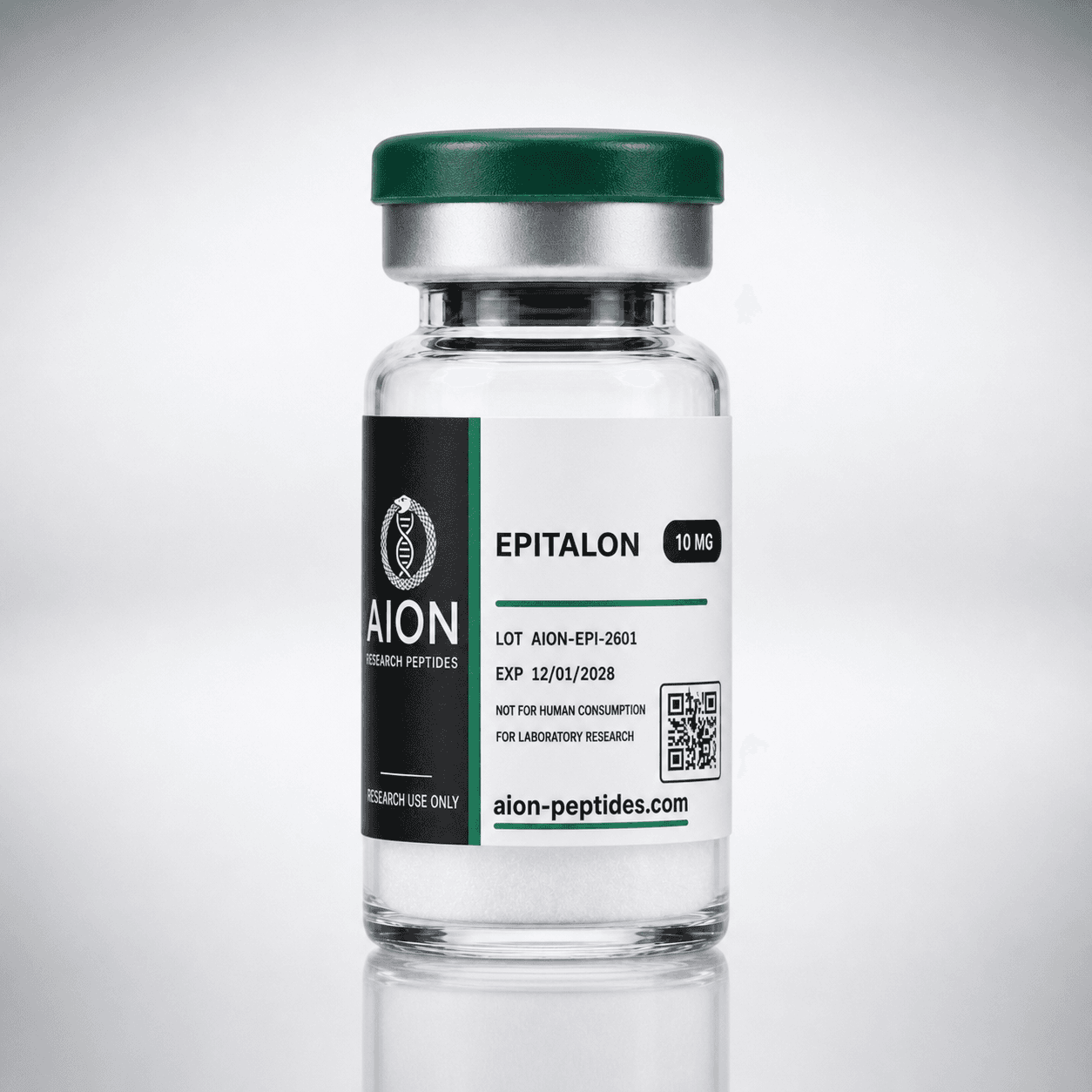
Epitalon 10mg
Epitalon is a synthetic tetrapeptide — alanyl-glutamyl-aspartyl-glycine — derived from epithalamin, a pineal gland extract characterised at the St Petersburg Institute of Bioregulation and Gerontology. It is the peptide most often cited in telomerase and pineal-regulation research. Supplied lyophilised. For laboratory research use only.
$49.99
About Epitalon in research
Epitalon is a synthetic tetrapeptide, Ala-Glu-Asp-Gly, studied mainly in cell culture for telomerase activity, pineal melatonin synthesis and gene expression. It was designed from the amino-acid composition of epithalamin, a polypeptide preparation from the bovine pineal gland, and a 2026 narrative review stresses that the two are chemically distinct and should be considered separately. The peptide also appears in the literature as Epithalon, Epithalone and AEDG peptide.
The telomerase work comes from the St Petersburg Institute of Bioregulation and Gerontology. Khavinson, Bondarev and Butyugov reported that adding epitalon to cultures of telomerase-negative human fetal fibroblasts induced expression of the telomerase catalytic subunit, telomerase enzymatic activity and telomere elongation. The authors attributed this to reactivation of the telomerase gene; that interpretation has not been established outside this group's work.
A second strand concerns the pineal gland. In rat pinealocyte culture, epitalon increased synthesis of arylalkylamine N-acetyltransferase (AANAT) and the transcription factor pCREB and raised the melatonin level in the culture medium, and adding norepinephrine together with the peptide strengthened the AANAT and pCREB response. In female rats given the neurotoxic compound 1,2-dimethylhydrazine, Arutjunyan and colleagues reported that epitalon prevented the disturbance of the daily dopamine rhythm in the median eminence and arcuate nuclei, a region involved in hypothalamic control of the reproductive cycle.
Gene-expression claims form a third strand. In human gingival mesenchymal stem cells, Khavinson and Italian collaborators reported 1.6- to 1.8-fold increases in mRNA for the neurogenic markers Nestin, GAP43, beta-III tubulin and doublecortin, with matching increases in protein synthesis. Molecular modelling in the same paper suggested the peptide binds histones H1/3 and H1/6 at DNA-interacting sites, which the authors proposed as an epigenetic mechanism; the binding was modelled rather than measured. An independent study from Chinese groups found that epitalon in the culture medium lowered reactive oxygen species, reduced spindle defects and abnormal cortical granule distribution, and raised mitochondrial membrane potential in mouse oocytes held in culture after ovulation.
Most of the primary literature, including the telomerase, pinealocyte and gene-expression studies above, comes from Khavinson and colleagues, and it has seen limited independent replication; the oocyte study is one of the few primary papers cited here from outside St Petersburg. The 2026 review by Jain and co-authors concluded that human evidence is limited to small physiological or biomarker studies and an older study in retinitis pigmentosa, that no adequately powered randomised trial exists, and that pharmacokinetic and long-term safety data are inadequate. The evidence for the mechanisms listed below is preclinical, drawn from cell culture and rodent models.
- Induction of telomerase catalytic subunit expression and telomerase activity, with telomere elongation, reported in human fetal fibroblast culture.
- Increased AANAT and pCREB synthesis with higher melatonin output, reported in rat pinealocyte culture.
- Binding to histones H1/3 and H1/6, proposed from molecular modelling as an epigenetic route to increased neurogenic gene expression in human gingival mesenchymal stem cells.
- Reduction of reactive oxygen species with preserved mitochondrial membrane potential, reported in mouse oocytes in vitro.
- Modulation of hypothalamic dopamine rhythms, reported in a rat model of 1,2-dimethylhydrazine neurotoxicity.
- Khavinson VKh, Bondarev IE, Butyugov AA (2003). Epithalon peptide induces telomerase activity and telomere elongation in human somatic cells. Bull Exp Biol Med. [IN VITRO] PubMed record for reference 1, Khavinson 2003
- Khavinson VKh, Linkova NS, Kvetnoy IM, et al. (2012). Molecular cellular mechanisms of peptide regulation of melatonin synthesis in pinealocyte culture. Bull Exp Biol Med. [IN VITRO] PubMed record for reference 2, Khavinson 2012
- Arutjunyan A, Kozina L, Milyutina Y, et al. (2012). Melatonin and pineal gland peptides are able to correct the impairment of reproductive cycles in rats. Curr Aging Sci. [RODENT] PubMed record for reference 3, Arutjunyan 2012
- Khavinson V, Diomede F, Mironova E, et al. (2020). AEDG Peptide (Epitalon) Stimulates Gene Expression and Protein Synthesis during Neurogenesis: Possible Epigenetic Mechanism. Molecules. [IN VITRO] PubMed record for reference 4, Khavinson 2020
- Yue X, Liu SL, Guo JN, et al. (2022). Epitalon protects against post-ovulatory aging-related damage of mouse oocytes in vitro. Aging (Albany NY). [IN VITRO] PubMed record for reference 5, Yue 2022
- Jain A, Gallacher DM, Issa MA, et al. (2026). Epitalon and Epithalamin: A Narrative Review of Mechanistic, Preclinical, and Clinical Evidence. Int J Mol Sci. [REVIEW] PubMed record for reference 6, Jain 2026
Identity
- SEQUENCE
- AEDG (Ala-Glu-Asp-Gly)
- MOLECULAR FORMULA
- C14H22N4O9
- MOLECULAR WEIGHT
- 390.35 g/mol
- CAS NUMBER
- 307297-39-8
- PUBCHEM CID
- 219042
Formula, weight and sequence from PubChem (CID 219042), with the formula and weight recomputed from the sequence; CAS from PubChem and the certificate of analysis, lot 20250510.
Storage and handling
- Keep the lyophilised powder sealed, dry and protected from light, typically at -20 °C or below for long-term storage; the certificate gives -80 °C to -20 °C long-term and 2–8 °C short-term. Allow the vial to reach room temperature before opening to limit moisture uptake.
- Once in solution, keep at 2–8 °C and use promptly. For longer storage, solutions are typically divided into aliquots and frozen at -20 °C or below, avoiding repeated freeze-thaw. Solution stability has not been established for this lot.
- The certificate reports the lot fully soluble in deionised water and normal saline, giving a clear, particle-free solution. Add the solvent slowly down the side of the vial and swirl gently rather than shaking.
- Adding 2 mL of sterile water to a 10 mg vial gives a 5 mg/mL stock solution.
Lab testing
Certificate of Analysis
THIRD-PARTY VERIFIED
Purity
99.83%
Lot
20250510
Certificate date
Jun 4, 2026
Laboratory
North South Precision Testing
TESTS REPORTED Purity · Impurities · Heavy metals (Pb, Cd, Hg, As) · Moisture, pH, solubility
Download Certificate of Analysis (PDF)Lab report issued by North South Precision Testing for the sourced batch. For laboratory research use only.
Questions
What is the sequence and formula of Epitalon?
Epitalon is the tetrapeptide AEDG: Ala-Glu-Asp-Gly. PubChem (CID 219042) gives the formula C14H22N4O9 and a molecular weight of 390.35 g/mol, both of which follow from the sequence, and lists CAS 307297-39-8, the number on the certificate.
How does Epitalon differ from epithalamin?
Epithalamin is a polypeptide preparation extracted from the bovine pineal gland. Epitalon is a single synthetic four-residue peptide designed from epithalamin's amino-acid composition. They are chemically distinct, and a 2026 review treats studies of the two separately. Some databases list epithalamin as a synonym, with its own CAS number, 64082-79-7.
How should Epitalon be stored in the lab?
As lyophilised powder, sealed, dry and away from light, typically at -20 °C or below for long-term storage. Once in solution, keep it at 2–8 °C and use it promptly, or freeze aliquots to avoid repeated freeze-thaw.
What does the certificate of analysis test?
The certificate for this lot, issued by North South Precision Testing, reports appearance, purity, impurities, moisture content, pH, solubility, residual solvents and heavy metals (lead, cadmium, mercury and arsenic). It identifies the material by name and CAS number but does not report a mass-spectrometry identity check. The measured purity and lot number are shown in the certificate panel on this page.
In which research models has Epitalon been studied?
Mainly in cell culture: human fetal fibroblasts for telomerase activity, rat pinealocytes for melatonin synthesis, human gingival mesenchymal stem cells for gene expression and mouse oocytes for oxidative stress. Animal work includes rat models of hypothalamic regulation. Much of this work comes from one St Petersburg group, and a 2026 review found no adequately powered human trial.
REVIEWED BY DEL POTTER, PHD · OCT 26, 2026
FOR LABORATORY RESEARCH USE ONLY · NOT FOR HUMAN OR ANIMAL USE · MUST BE 21+