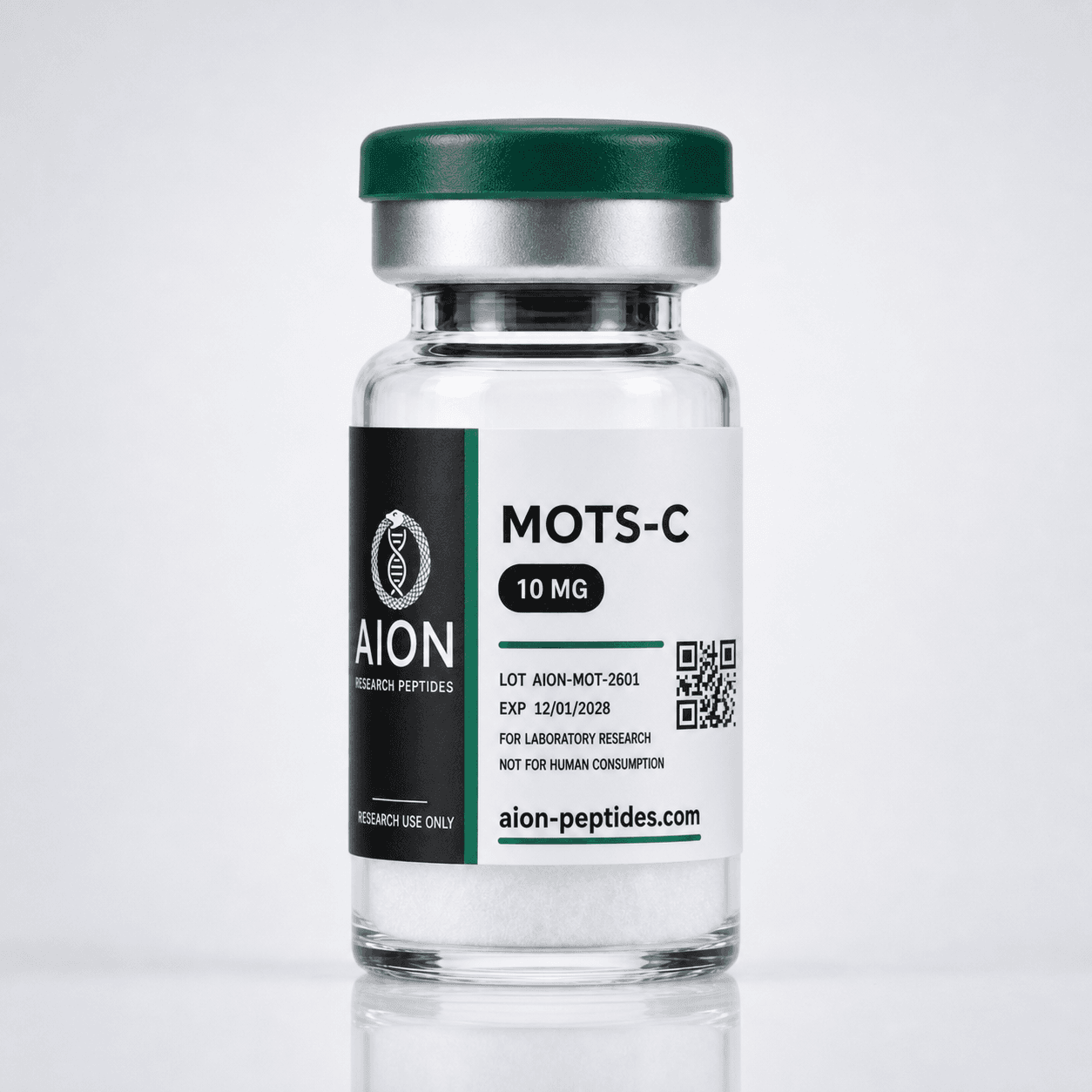
MOTS-c 10mg
MOTS-c is a sixteen-amino-acid peptide encoded not in nuclear DNA but within the mitochondrial 12S rRNA gene — one of a small number of known mitochondrial-derived peptides. That origin is why it is studied as a signalling molecule between the mitochondria and the nucleus, particularly in metabolic-regulation and AMPK-pathway research. Supplied lyophilised. Independently assayed by a third-party laboratory, named on this page; the certificate of analysis for this lot, with its measured purity and batch number, is published on this page. For laboratory research use only.
$70.00
About MOTS-c in research
MOTS-c is a 16-residue peptide encoded in the mitochondrial 12S rRNA gene, studied in AMPK signalling and metabolic research in cells and mice. Its name stands for mitochondrial open reading frame of the 12S rRNA type-c. It was described in 2015 by Lee and colleagues, who identified a short open reading frame within the 12S rRNA gene of mitochondrial DNA and showed that it encodes a signalling peptide. Together with humanin, it is one of the mitochondrial-derived peptides used to study how mitochondria send signals to the rest of the cell.
The founding paper combined cell and mouse work. In cultured cells, Lee and colleagues reported that MOTS-c inhibited the folate cycle and the de novo purine biosynthesis linked to it, leading to activation of AMPK, and they identified skeletal muscle as its apparent primary target tissue. In mice fed a high-fat diet, MOTS-c treatment was reported to prevent diet-induced insulin resistance and diet-induced obesity. A later study from the same group used untargeted plasma metabolomics in diet-induced obese mice: sphingolipid, monoacylglycerol and dicarboxylate metabolism pathways were reduced in treated animals, and the authors reported improved insulin sensitivity, increased beta-oxidation, reduced diet-induced weight gain and less fatty liver.
A second line of work concerns where the peptide acts inside the cell. Kim and colleagues reported that under metabolic stress, such as glucose restriction, MOTS-c moved from the cytoplasm into the nucleus in an AMPK-dependent manner. There it regulated a broad set of nuclear genes, including genes with antioxidant response elements, and interacted with stress-responsive transcription factors such as NRF2. A review by Benayoun and Lee discusses these findings as a case of a mitochondrial-encoded factor regulating nuclear gene expression, and frames the idea that the mitochondrial and nuclear genomes cross-regulate each other as a hypothesis.
Other groups have used MOTS-c in different mouse models. In ovariectomised mice, Ming and colleagues reported less bone loss on micro-CT in treated animals. In cell work in the same paper, MOTS-c inhibited RANKL-induced osteoclast differentiation and increased AMPK phosphorylation, and the AMPK inhibitor compound C partially reversed the effect on osteoclast formation.
The evidence base is preclinical. The studies described here were carried out in cultured cells and mice, and much of the foundational work comes from a small number of laboratories at the University of Southern California. The pathways listed below are proposals drawn from individual models, not an established account of how the peptide acts, and none of these findings has been established in humans.
- Inhibition of the folate cycle and linked de novo purine biosynthesis, proposed to lead to AMPK activation, reported in cultured cells.
- Skeletal muscle as the primary target tissue, proposed from mouse studies of high-fat-diet-induced insulin resistance.
- AMPK-dependent translocation to the nucleus under glucose restriction, with regulation of antioxidant response element genes, reported in cultured cells.
- Interaction with stress-responsive transcription factors such as NRF2, reported in cultured cells.
- AMPK-dependent inhibition of RANKL-induced osteoclast differentiation, reported in vitro and in an ovariectomised mouse model.
- Lee C, Zeng J, et al. (2015). The mitochondrial-derived peptide MOTS-c promotes metabolic homeostasis and reduces obesity and insulin resistance. Cell Metab. [RODENT] PubMed record for reference 1, Lee 2015
- Kim KH, Son JM, et al. (2018). The Mitochondrial-Encoded Peptide MOTS-c Translocates to the Nucleus to Regulate Nuclear Gene Expression in Response to Metabolic Stress. Cell Metab. [IN VITRO] PubMed record for reference 2, Kim 2018
- Kim SJ, Miller B, et al. (2019). The mitochondrial-derived peptide MOTS-c is a regulator of plasma metabolites and enhances insulin sensitivity. Physiol Rep. [RODENT] PubMed record for reference 3, Kim 2019
- Ming W, Lu G, et al. (2016). Mitochondria related peptide MOTS-c suppresses ovariectomy-induced bone loss via AMPK activation. Biochem Biophys Res Commun. [RODENT] PubMed record for reference 4, Ming 2016
- Benayoun BA, Lee C (2019). MOTS-c: A Mitochondrial-Encoded Regulator of the Nucleus. Bioessays. [REVIEW] PubMed record for reference 5, Benayoun 2019
- Lee C, Kim KH, Cohen P (2016). MOTS-c: A novel mitochondrial-derived peptide regulating muscle and fat metabolism. Free Radic Biol Med. [REVIEW] PubMed record for reference 6, Lee 2016
Identity
- SEQUENCE
- MRWQEMGYIFYPRKLR (Met-Arg-Trp-Gln-Glu-Met-Gly-Tyr-Ile-Phe-Tyr-Pro-Arg-Lys-Leu-Arg)
- MOLECULAR FORMULA
- C101H152N28O22S2
- MOLECULAR WEIGHT
- 2174.6 g/mol
- CAS NUMBER
- 1627580-64-6
- PUBCHEM CID
- 146675088
Formula, weight, sequence and CAS from PubChem (CID 146675088), with the formula recomputed from the sequence; checked against the certificate of analysis, lot ABL-MOT-2602.
Storage and handling
- Keep the lyophilised powder sealed, dry and protected from light, typically at -20 °C for long-term storage. Allow the vial to reach room temperature before opening to limit moisture uptake.
- Once in solution, keep at 2–8 °C and use promptly. For longer storage, solutions are typically divided into aliquots and frozen at -20 °C or below, avoiding repeated freeze-thaw. Solution stability has not been established for this lot.
- Generally soluble in sterile water and common aqueous buffers. Add the solvent slowly down the side of the vial and swirl gently rather than shaking.
- Adding 2 mL of sterile water to a 10 mg vial gives a 5 mg/mL stock solution.
Lab testing
Certificate of Analysis
THIRD-PARTY VERIFIED
Purity
99.098%
Lot
ABL-MOT-2602
Formula (corrected)
C101H152N28O22S2
Certificate date
Jun 18, 2026
Laboratory
Janoshik
FORMULA CORRECTED The certificate prints C100H162N28O25S. MOTS-c contains two methionines, so two sulfur atoms; the corrected formula matches the certificate's own molecular weight (2174.6 g/mol).
TESTS REPORTED Purity (HPLC)
Download Certificate of Analysis (PDF)Lab report issued by Janoshik for the sourced batch. For laboratory research use only.
Questions
What is the amino acid sequence of MOTS-c?
MRWQEMGYIFYPRKLR: Met-Arg-Trp-Gln-Glu-Met-Gly-Tyr-Ile-Phe-Tyr-Pro-Arg-Lys-Leu-Arg, sixteen residues. PubChem (CID 146675088) gives the formula C101H152N28O22S2 and a molecular weight of 2174.6 g/mol, and lists CAS 1627580-64-6.
How does MOTS-c differ from humanin?
Both are mitochondrial-derived peptides, encoded by short open reading frames in mitochondrial DNA rather than in the nucleus. They are different peptides from different genes: MOTS-c comes from the 12S rRNA gene and humanin from the 16S rRNA gene. MOTS-c is the one studied in the folate cycle, AMPK and nuclear gene-regulation work described on this page.
How should MOTS-c be stored in the lab?
As lyophilised powder, sealed, dry and away from light, typically at -20 °C for long-term storage. Once in solution, keep it at 2–8 °C and use it promptly, or freeze aliquots to avoid repeated freeze-thaw. Solution stability has not been established for this lot.
What does the certificate of analysis test?
The certificate for this lot, issued by Janoshik, reports chromatographic purity by HPLC with UV detection at 214 nm, and the measured peptide content of the vial. It does not include an identity test such as mass spectrometry: the formula, molecular weight and CAS number printed on it are reference information, not measurements. The measured purity and lot number are shown in the certificate panel on this page.
In which research models has MOTS-c been studied?
Mainly in cultured cells and mice. Cell work covers the folate cycle, AMPK activation, nuclear translocation under glucose restriction and osteoclast differentiation. Mouse work includes high-fat-diet models of insulin resistance, plasma metabolomics in diet-induced obese mice and an ovariectomy model of bone loss. These findings have not been established in humans.
REVIEWED BY DEL POTTER, PHD · OCT 26, 2026
FOR LABORATORY RESEARCH USE ONLY · NOT FOR HUMAN OR ANIMAL USE · MUST BE 21+