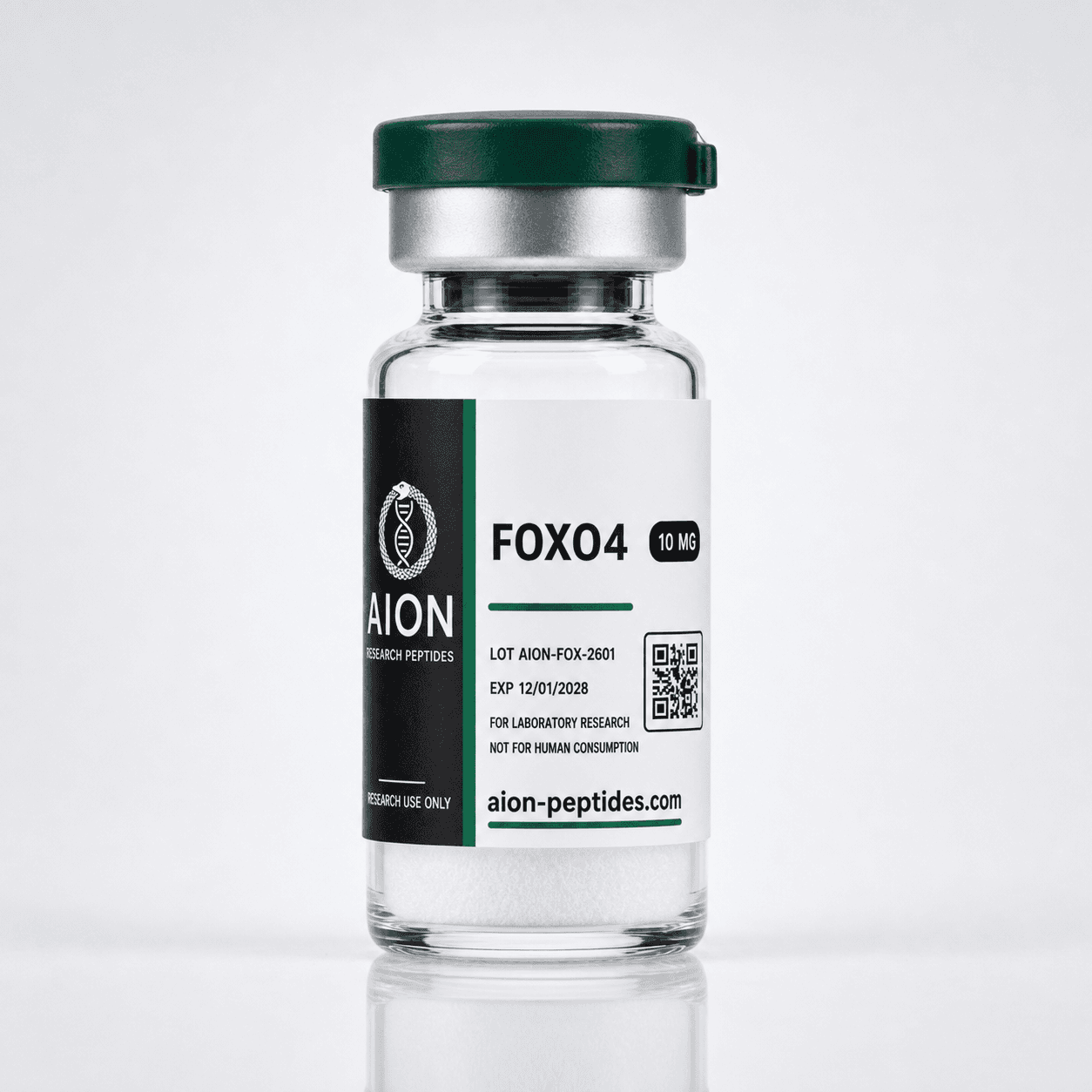
FOXO4 10mg
FOXO4-DRI is a retro-inverso peptide: built from D-amino acids in reversed sequence, which makes it resistant to the proteases that would degrade the natural form. It was designed to interfere with the FOXO4–p53 interaction, and is the reference compound in senolytic research concerned with the selective clearance of senescent cells. Supplied lyophilised. For laboratory research use only.
$140.00
About FOXO4 in research
FOXO4-DRI is a 46-residue D-retro-inverso peptide designed to disrupt the FOXO4-p53 interaction, studied in senescent cells in culture and in rodent models. The compound sold here as FOXO4 is this peptide, not the FOXO4 protein itself: FOXO4 is a forkhead box transcription factor, while FOXO4-DRI is a synthetic mimic of one region of it, built from D-amino acids in reversed sequence so that it resists the proteases that degrade the natural L-form. Its C-terminal segment is the HIV-TAT cell-penetrating sequence, which is what carries it into cells.
The peptide was reported by Baar and colleagues at Erasmus MC in Cell in 2017. That paper identified FOXO4 as a factor that keeps p53 in the nucleus of senescent cells, and designed the DRI peptide to compete for that interaction. In senescent IMR90 fibroblasts the peptide caused nuclear exclusion of Ser15-phosphorylated p53 and cell-intrinsic apoptosis, while cells that had not undergone senescence were much less affected. The same paper reported effects in mice exposed to doxorubicin, in the fast-ageing XpdTTD/TTD strain and in naturally aged wild-type animals; the authors described the peptide as well tolerated under the conditions they tested, which they framed as a first step rather than a settled safety finding.
Later work has used the peptide mainly as a reference senolytic in cell and rodent models. Huang and colleagues applied it to human articular chondrocytes expanded in vitro, where it removed more than half of the cells at population doubling level 9 but left minimally expanded cells largely unaffected; it did not improve the chondrogenic capacity of the surviving cells, and p21 levels rose in the treated group, which the authors read as a possible stress response. Kong and colleagues reported apoptosis of senescent fibroblasts in keloid organ culture with p53-Ser15 nuclear exclusion. In mice, Liu and colleagues reported less collagen deposition and milder histology in a bleomycin pulmonary fibrosis model.
Not all reported outcomes point the same way. Born and colleagues, in a Circulation study of pulmonary hypertension, found that clearing senescent pulmonary endothelial cells, with FOXO4-DRI among the agents used, worsened pulmonary haemodynamics in mouse models, and concluded that senolytic strategies need to be assessed per tissue and context. Structural work by Bourgeois and colleagues has since mapped the binding surface: solution NMR shows the disordered peptide engaging the disordered p53 transactivation domain to form a transiently folded complex, with both the FOXO4-derived region and the cationic cell-permeability segment contributing.
A 2026 narrative review in Antioxidants notes that FOXO4-specific evidence is a small subset of the wider FOXO literature, that much of what is said about FOXO4 is extrapolated from FOXO1 and FOXO3, and that the senolytic activity of FOXO4-DRI has been shown in preclinical models but has not been clinically validated. Independent replication of the original in vivo findings remains limited, and several of the structural and mechanistic papers come from the groups that designed the peptide. All of the evidence above is preclinical: cell culture and rodent work, with no human clinical data.
- Competitive disruption of the FOXO4-p53 interaction, proposed as the design rationale and shown by NMR titration of the FOXO4 forkhead domain and the p53 transactivation domain in vitro.
- Nuclear exclusion of Ser15-phosphorylated p53, reported in senescent IMR90 fibroblasts and in senescent keloid fibroblasts.
- Selective apoptosis of senescent cells with little effect on non-senescent cells, reported in cultured human chondrocytes and in irradiation- and doxorubicin-senescent fibroblasts.
- Activation of a p53/BCL-2/caspase-3 route, reported in oxygen-glucose-deprived endothelial cells.
- Cellular entry via the C-terminal HIV-TAT segment, proposed in the original design and tracked with an anti-TAT antibody in treated cells.
- Baar MP, Brandt RMC, Putavet DA, et al. (2017). Targeted Apoptosis of Senescent Cells Restores Tissue Homeostasis in Response to Chemotoxicity and Aging. Cell. [RODENT] PubMed record for reference 1, Baar 2017
- Bourgeois B, Spreitzer E, Platero-Rochart D, et al. (2025). The disordered p53 transactivation domain is the target of FOXO4 and the senolytic compound FOXO4-DRI. Nat Commun. [IN VITRO] PubMed record for reference 2, Bourgeois 2025
- Huang Y, He Y, Makarcyzk MJ, Lin H (2021). Senolytic Peptide FOXO4-DRI Selectively Removes Senescent Cells From in vitro Expanded Human Chondrocytes. Front Bioeng Biotechnol. [IN VITRO] PubMed record for reference 3, Huang 2021
- Kong YX, Li ZS, Liu YB, et al. (2025). FOXO4-DRI induces keloid senescent fibroblast apoptosis by promoting nuclear exclusion of upregulated p53-serine 15 phosphorylation. Commun Biol. [IN VITRO] PubMed record for reference 4, Kong 2025
- Born E, Lipskaia L, Breau M, et al. (2023). Eliminating Senescent Cells Can Promote Pulmonary Hypertension Development and Progression. Circulation. [RODENT] PubMed record for reference 5, Born 2023
- Mateescu DM, Gavrilescu DM, Marinescu AR, et al. (2026). FOXO4 as a Redox-Sensitive Regulator of Antioxidant Defense and Cellular Senescence: Cysteine-Based Signaling, p53 Interaction, and Therapeutic Targeting. Antioxidants (Basel). [REVIEW] PubMed record for reference 6, Mateescu 2026
Identity
- SEQUENCE
- LTLRKEPASEIAQSILEAYSQNGWANRRSGGKRPPPRRRQRRKKRG (46 residues, all-D amino acids in retro-inverso order; the C-terminal KRPPPRRRQRRKKRG segment is the HIV-TAT cell-penetrating sequence)
- MOLECULAR FORMULA
- C228H388N86O64
- MOLECULAR WEIGHT
- 5358 g/mol
- CAS NUMBER
- 2460055-10-9
- PUBCHEM CID
- 167312269
Sequence from the methods of Baar et al. (Cell, 2017); formula and weight from PubChem (CID 167312269) and recomputed from that sequence; CAS from PubChem's depositor-supplied synonyms. No certificate of analysis has been published for this product, so none of these figures has been checked against a lot-specific assay.
Storage and handling
- Keep the lyophilised powder sealed, dry and protected from light, typically at -20 °C for long-term storage. Baar et al. stored their material at -20 °C in 1 mg powder aliquots to avoid freeze-thaw artefacts. Allow the vial to reach room temperature before opening to limit moisture uptake.
- Once in solution, keep at 2-8 °C and use promptly. For longer storage, solutions are typically divided into aliquots and frozen at -20 °C or below, avoiding repeated freeze-thaw. Solution stability has not been established for this lot.
- This is a highly basic peptide, with a long arginine- and lysine-rich segment, and is generally soluble in sterile water and common aqueous buffers. Add the solvent slowly down the side of the vial and swirl gently rather than shaking.
- Adding 2 mL of sterile water to a 10 mg vial gives a 5 mg/mL stock solution, about 0.93 mM at a molecular weight of 5358 g/mol.
Lab testing
Certificate of Analysis
No certificate of analysis is published for this product yet. Where a certificate exists we publish it in full, as issued by the laboratory — the measured purity, the lot number and the date of analysis, not a summary written by us.
Certificates are being obtained for the remainder of the catalogue.
Questions
Is this the FOXO4 protein or the FOXO4-DRI peptide?
The research compound is the peptide FOXO4-DRI, not the FOXO4 protein. FOXO4 is a forkhead box transcription factor of around 500 residues; FOXO4-DRI is a 46-residue synthetic peptide, LTLRKEPASEIAQSILEAYSQNGWANRRSGGKRPPPRRRQRRKKRG, made from D-amino acids in retro-inverso order and fused to the HIV-TAT cell-penetrating sequence. PubChem (CID 167312269) gives the formula C228H388N86O64 and a molecular weight of 5358 g/mol, and lists CAS 2460055-10-9.
What does "D-retro-inverso" mean here, and how does it differ from the natural sequence?
A D-retro-inverso peptide reverses the order of the residues and replaces each L-amino acid with its D-enantiomer, which approximates the side-chain topology of the original while resisting the proteases that cleave L-peptides. Baar et al. designed FOXO4-DRI from a region of FOXO4 implicated in p53 binding on that principle; it is a mimic of that region rather than a fragment of the protein.
How should FOXO4-DRI be stored in the lab?
As lyophilised powder, sealed, dry and away from light, typically at -20 °C for long-term storage. The original paper used 1 mg powder aliquots at -20 °C to avoid freeze-thaw artefacts. Once in solution, keep it at 2-8 °C and use it promptly, or freeze aliquots.
Is there a certificate of analysis for this product?
Not yet. No certificate of analysis has been published for this product, and the COA library at /coa lists it as in progress. We make no claim about the purity or identity of this material, and the figures in the identity table above come from the published literature and PubChem rather than from any assay of this lot. Where a certificate exists, we publish it in full as issued by the laboratory, naming the tests performed.
In which research models has FOXO4-DRI been studied?
In cell culture: senescent IMR90 human fibroblasts, in vitro expanded human chondrocytes, keloid fibroblasts and organ cultures, and endothelial cells, plus NMR work on recombinant FOXO4 and p53 fragments. In rodents: mouse models of doxorubicin-induced senescence, the fast-ageing XpdTTD/TTD strain, naturally aged mice, bleomycin-induced pulmonary fibrosis and pulmonary hypertension models, the last of which reported worse haemodynamics after senescent-cell clearance. There are no human clinical data, and a 2026 review notes the peptide has not been clinically validated.
REVIEWED BY DEL POTTER, PHD · OCT 26, 2026
FOR LABORATORY RESEARCH USE ONLY · NOT FOR HUMAN OR ANIMAL USE · MUST BE 21+