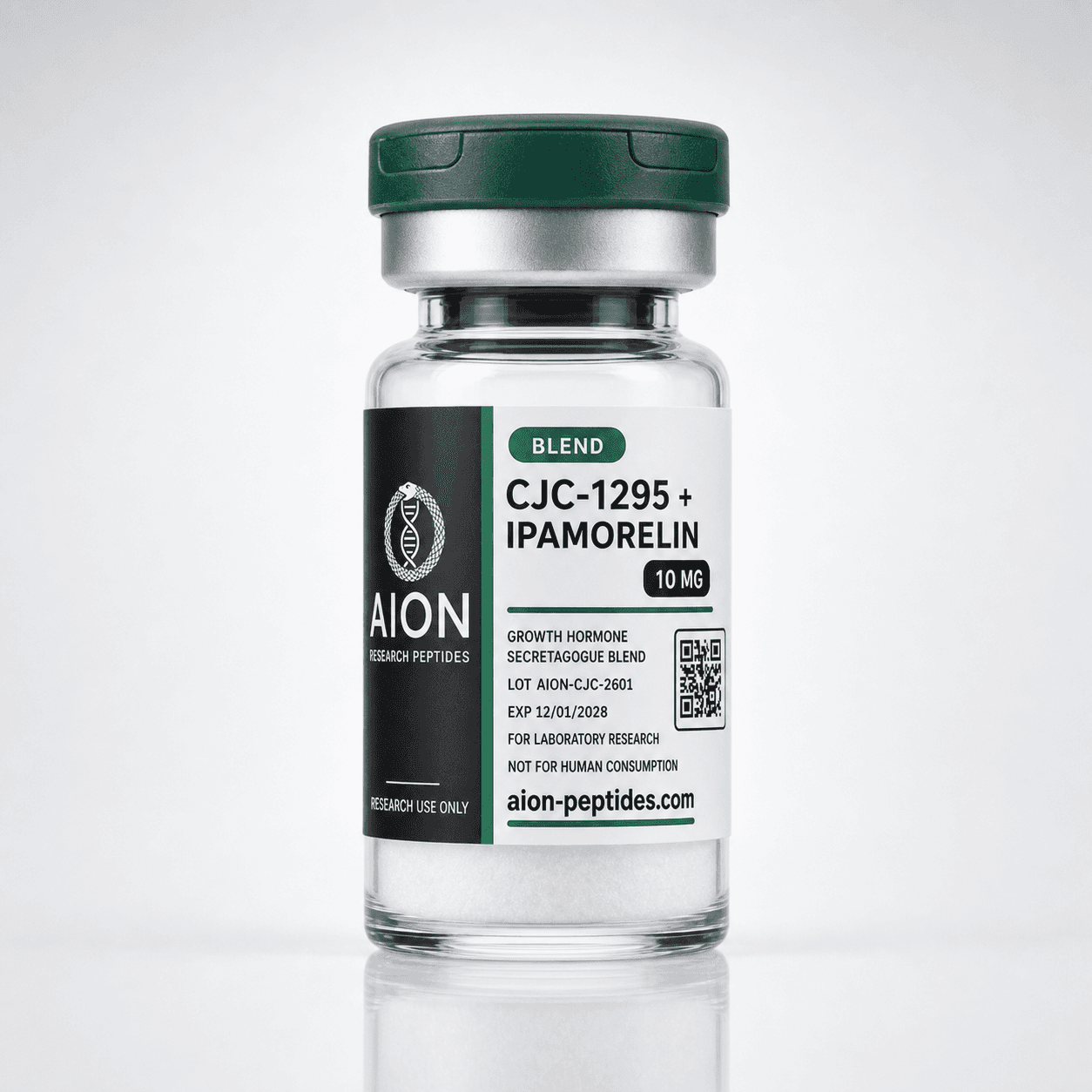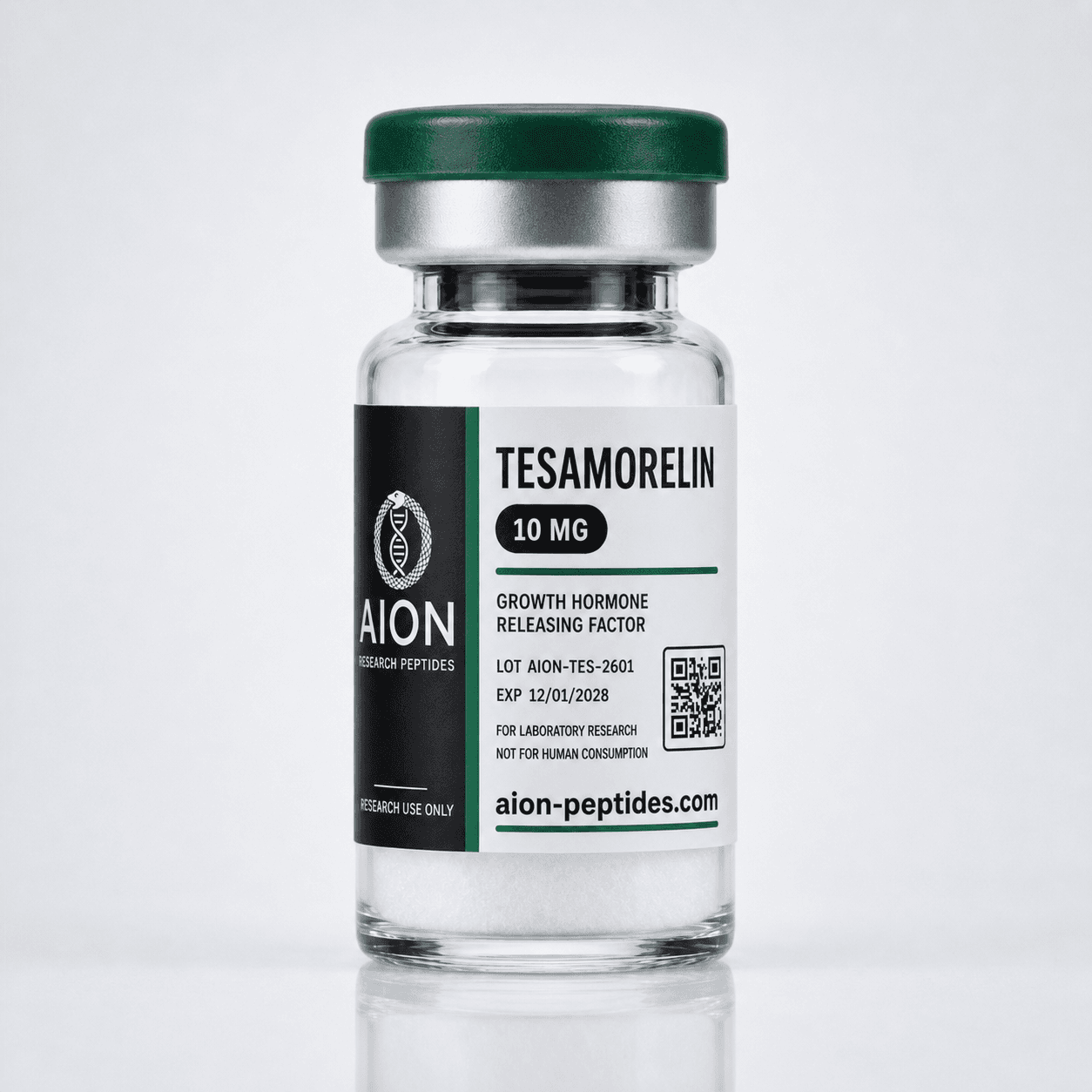
Tesamorelin 10mg
Tesamorelin is a synthetic analogue of growth-hormone-releasing hormone — the full 44-residue GRF sequence with a trans-3-hexenoyl group at the N-terminus, which protects it from dipeptidyl peptidase degradation. It is studied for its action at the GHRH receptor and appears in endocrine and adipose-distribution research. Supplied lyophilised. Independently assayed by a third-party laboratory, named on this page; the certificate of analysis for this lot, with its measured purity and batch number, is published on this page. For laboratory research use only.
$69.99
About Tesamorelin in research
Tesamorelin is a synthetic analogue of growth hormone-releasing hormone (GHRH 1-44) studied at the GHRH receptor and in GH/IGF-1 axis research. It is the full 44-residue human GRF sequence with a trans-3-hexenoyl group added to the N-terminal tyrosine. In non-clinical work this modification made the peptide resistant to inactivation by dipeptidyl aminopeptidase-IV and slowed its in vitro degradation in rat, dog and human plasma compared with native hGRF(1-44)-NH2 [Ferdinandi 2007].
The same non-clinical programme reported that repeated daily exposure in pigs, rats and dogs markedly increased plasma growth hormone and insulin-like growth factor-1 (IGF-1). In subchronic studies in rats and dogs lasting up to four months, investigators reported increased body-weight gain alongside the biomarker response, and in dogs a more pronounced anabolic effect with reversible liver, kidney and blood findings that they attributed to sustained supraphysiological GH and IGF-1 exposure [Ferdinandi 2007]. These findings place tesamorelin among the GHRH-receptor agonists used to study pituitary GH output in animal models.
In human clinical research, a two-week study in thirteen healthy men measured GH by overnight frequent sampling. Investigators reported increases in mean overnight GH, GH peak area and basal GH secretion, and a rise in IGF-1, while fasting glucose and insulin-stimulated glucose uptake measured by euglycemic clamp were not significantly changed [Stanley 2011]. The study is often cited as evidence that a GHRH(1-44) analogue augments pulsatile, rather than only basal, GH secretion.
Much of the published clinical record concerns HIV-associated abdominal fat accumulation. In a randomized, placebo-controlled trial of 412 participants over 26 weeks, visceral adipose tissue measured by computed tomography decreased by 15.2% in the tesamorelin group and increased by 5.0% in the placebo group; triglycerides and the total-to-HDL cholesterol ratio also fell, IGF-1 rose by 81%, and glycemic measures did not differ significantly between groups [Falutz 2007]. A smaller single-centre randomized trial of 50 participants reported reductions in both visceral adipose tissue and liver fat over six months, with a transient rise in fasting glucose at two weeks that was not significant at six months; the authors described the liver-fat findings as preliminary [Stanley 2014].
Liver research continued in a randomized, double-blind, multicentre trial in people with HIV and non-alcoholic fatty liver disease. Over twelve months the tesamorelin group showed a greater reduction in hepatic fat fraction, measured by proton magnetic resonance spectroscopy, than the placebo group, with no between-group difference in fasting glucose or glycated haemoglobin at twelve months; the authors called for further study of long-term effects on liver histology [Stanley 2019]. Together these studies make tesamorelin a reference compound for research into the GH/IGF-1 axis, visceral adiposity and hepatic fat in defined clinical populations.
- Resistant to dipeptidyl aminopeptidase-IV inactivation, with slower degradation than native hGRF(1-44)-NH2 in rat, dog and human plasma in vitro [Ferdinandi 2007].
- Increased plasma GH and IGF-1 with repeated exposure in pigs, rats and dogs [Ferdinandi 2007].
- Augmented basal and pulsatile GH secretion in healthy men measured by overnight frequent sampling (human clinical) [Stanley 2011].
- Raised IGF-1 and reduced CT-measured visceral adipose tissue in randomized trials in HIV-associated abdominal fat accumulation (human clinical) [Falutz 2007; Stanley 2014].
- Reduced hepatic fat fraction measured by magnetic resonance spectroscopy in a randomized trial in HIV-associated non-alcoholic fatty liver disease (human clinical) [Stanley 2019].
- Ferdinandi ES, Brazeau P, High K, et al. (2007). Non-clinical pharmacology and safety evaluation of TH9507, a human growth hormone-releasing factor analogue. Basic Clin Pharmacol Toxicol. [OTHER ANIMAL] PubMed record for reference 1, Ferdinandi 2007
- Stanley TL, Chen CY, Branch KL, et al. (2011). Effects of a growth hormone-releasing hormone analog on endogenous GH pulsatility and insulin sensitivity in healthy men. J Clin Endocrinol Metab. [HUMAN CLINICAL] PubMed record for reference 2, Stanley 2011
- Falutz J, Allas S, Blot K, et al. (2007). Metabolic effects of a growth hormone-releasing factor in patients with HIV. N Engl J Med. [HUMAN CLINICAL] PubMed record for reference 3, Falutz 2007
- Stanley TL, Feldpausch MN, Oh J, et al. (2014). Effect of tesamorelin on visceral fat and liver fat in HIV-infected patients with abdominal fat accumulation: a randomized clinical trial. JAMA. [HUMAN CLINICAL] PubMed record for reference 4, Stanley 2014
- Stanley TL, Fourman LT, Feldpausch MN, et al. (2019). Effects of tesamorelin on non-alcoholic fatty liver disease in HIV: a randomised, double-blind, multicentre trial. Lancet HIV. [HUMAN CLINICAL] PubMed record for reference 5, Stanley 2019
- Prakash A, Goa KL (1999). Sermorelin: a review of its use in the diagnosis and treatment of children with idiopathic growth hormone deficiency. BioDrugs. [REVIEW] PubMed record for reference 6, Prakash 1999
Identity
- SEQUENCE
- (trans-3-hexenoyl)-Tyr-Ala-Asp-Ala-Ile-Phe-Thr-Asn-Ser-Tyr-Arg-Lys-Val-Leu-Gly-Gln-Leu-Ser-Ala-Arg-Lys-Leu-Leu-Gln-Asp-Ile-Met-Ser-Arg-Gln-Gln-Gly-Glu-Ser-Asn-Gln-Glu-Arg-Gly-Ala-Arg-Ala-Arg-Leu-NH2
- MOLECULAR FORMULA
- C221H366N72O67S
- MOLECULAR WEIGHT
- 5136 g/mol
- CAS NUMBER
- 218949-48-5
- PUBCHEM CID
- 16137828
Formula, molecular weight, CAS number and sequence from PubChem (CID 16137828), checked against the published structure of tesamorelin.
Storage and handling
- Store the lyophilized powder sealed at -20 °C or below, protected from light and moisture. Allow the vial to reach room temperature before opening to limit condensation.
- Keep reconstituted solution at 2–8 °C and prepare it as close as possible to the experiment. For longer storage, divide into single-use aliquots and freeze at -20 °C or below, avoiding repeated freeze–thaw. Stability in solution has not been established for this lot.
- Reconstitute in sterile water. Add the solvent slowly down the vial wall and swirl gently rather than shaking; confirm the solution is clear before use in an assay.
- Adding 2.0 mL of sterile water to the 10 mg vial gives a 5 mg/mL stock solution; adding 5.0 mL gives 2 mg/mL. Dilute further in assay buffer as the experiment requires.
Lab testing
Certificate of Analysis
THIRD-PARTY VERIFIED
Purity
99.82%
Lot
ABL-TES-2602
Formula (corrected)
C221H366N72O67S
Certificate date
Jun 18, 2026
Laboratory
Freedom Diagnostics
FORMULA CORRECTED The certificate prints C223H346N44O69S. It does not match tesamorelin's structure or the certificate's own molecular weight (5135.85 g/mol); the corrected formula does.
TESTS REPORTED Purity (HPLC-UV) · Identity by mass (LC-MS)
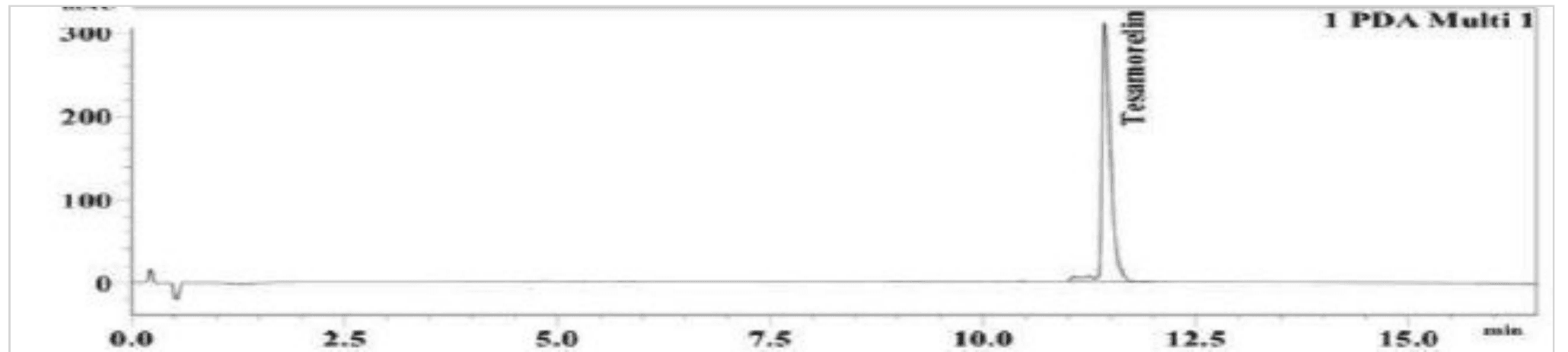
Lab report issued by Freedom Diagnostics for the sourced batch. For laboratory research use only.
Questions
How does tesamorelin differ from native GHRH and from sermorelin?
Tesamorelin keeps the full 44-residue human GRF sequence and adds a trans-3-hexenoyl group to the N-terminal tyrosine, which in non-clinical work made it resistant to dipeptidyl aminopeptidase-IV and slowed its degradation in plasma compared with native hGRF(1-44)-NH2 (Ferdinandi 2007). Sermorelin is a shorter, 29-residue analogue of GHRH, described as the shortest synthetic peptide with the full biological activity of GHRH (Prakash and Goa 1999).
What are tesamorelin's formula and molecular weight?
PubChem (CID 16137828) lists the formula C221H366N72O67S and a molecular weight of about 5136 g/mol, with CAS number 218949-48-5. These match the 44-residue sequence with its hexenoyl cap and C-terminal amide shown in the identity table.
How should the lyophilized and reconstituted material be stored?
Keep the sealed powder at -20 °C or below, away from light and moisture. Once reconstituted in sterile water, keep the solution at 2–8 °C for short periods, or aliquot and freeze it to avoid repeated freeze–thaw. Stability in solution has not been established for this lot, so prepare solutions close to the experiment.
What does the certificate of analysis test?
The certificate for this lot reports purity by HPLC-UV and identity by mass using LC-MS, from the third-party laboratory named on this page. Purity, lot number and certificate date are shown with the certificate itself.
In which research models has tesamorelin been studied?
Published work includes in vitro plasma stability studies and pharmacology in pigs, rats and dogs (Ferdinandi 2007), a GH secretion study in healthy men (Stanley 2011), and randomized human clinical trials in HIV-associated abdominal fat accumulation and non-alcoholic fatty liver disease (Falutz 2007; Stanley 2014; Stanley 2019).
REVIEWED BY DEL POTTER, PHD · OCT 26, 2026
FOR LABORATORY RESEARCH USE ONLY · NOT FOR HUMAN OR ANIMAL USE · MUST BE 21+