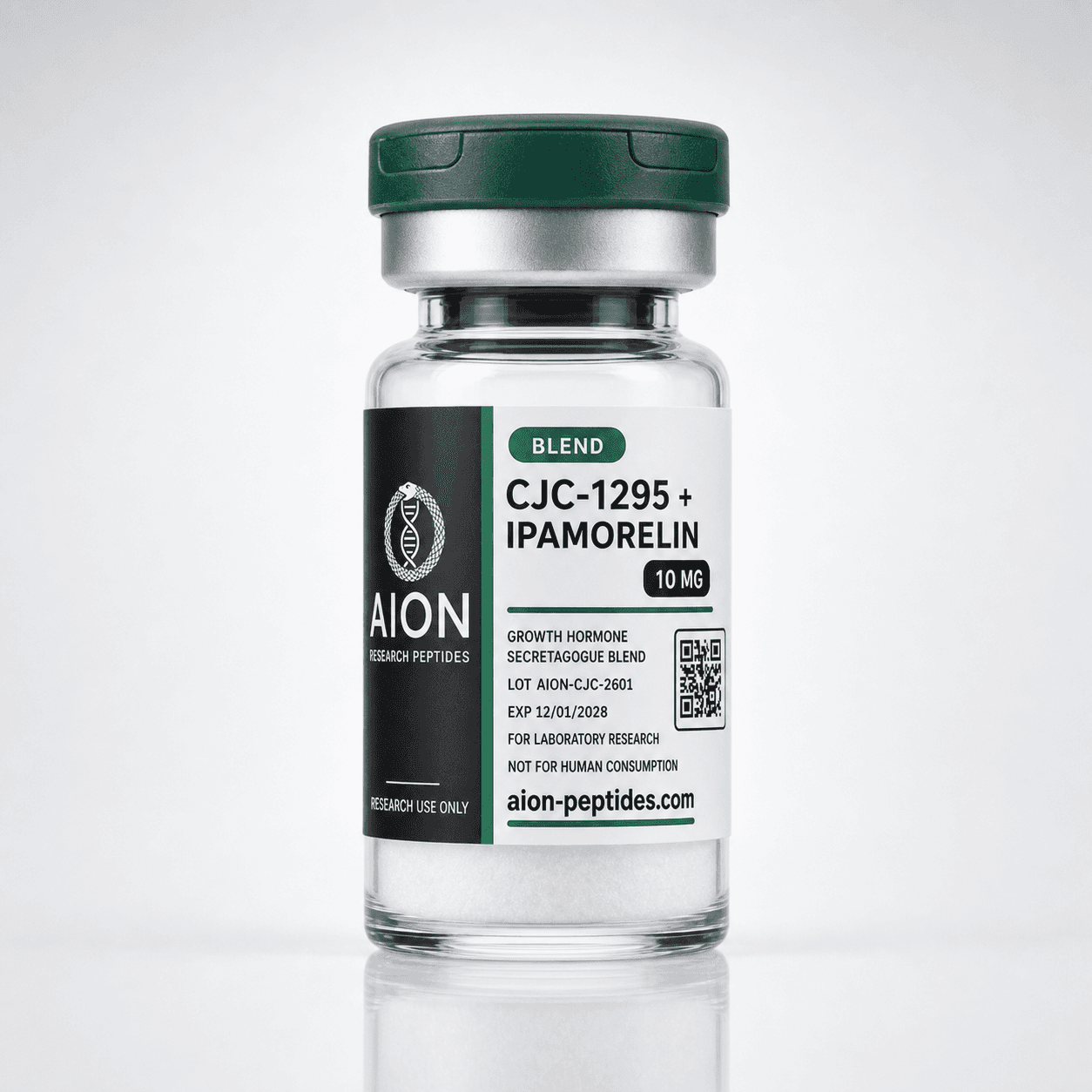
CJC-1295 + Ipamorelin 10mg (blend)
A blend of two secretagogues studied together for their complementary mechanisms. CJC-1295 is a synthetic analogue of growth-hormone-releasing hormone, based on a modified GRF(1-29) sequence whose substitutions resist enzymatic degradation. Ipamorelin is a selective pentapeptide agonist at the ghrelin receptor. Because the two act on separate receptor pathways, the pair appears frequently in endocrine research examining pulsatile secretion. Supplied lyophilised. For laboratory research use only.
$110.00
About CJC-1295 + Ipamorelin in research
CJC-1295 + Ipamorelin is a 10 mg research blend of a GHRH analogue and a ghrelin-receptor agonist, two peptides each studied separately in laboratory models. The published research described on this page concerns the individual compounds. We know of no published study of this combination, and nothing here should be read as evidence that the two act together, or that the mixture behaves differently from its parts.
The name CJC-1295 is used for two different molecules. In the published literature it refers to a tetrasubstituted form of human GRF(1-29), the first 29 residues of growth hormone-releasing hormone, with an added C-terminal lysine carrying a maleimidopropionyl group, the drug affinity complex (DAC), which binds covalently to serum albumin (Jetté et al., 2005). The name is also widely applied to the same tetrasubstituted GRF(1-29) without that lysine and DAC group, often called modified GRF(1-29). The product page describes this component as a modified GRF(1-29) sequence but does not say whether the DAC group is present, so it is not known from the listing which of the two is supplied. The CJC-1295 studies cited below all used the DAC form, and their pharmacokinetic findings, which depend on albumin binding, should not be assumed to apply to the version without it.
Jetté and colleagues synthesised three maleimido derivatives of hGRF(1-29) and conjugated them to human serum albumin. The conjugates were more stable than unmodified hGRF(1-29) against dipeptidyl peptidase-IV and released growth hormone from cultured rat anterior pituitary cells. In male Sprague Dawley rats the selected compound, CJC-1295, gave a four-fold larger growth hormone area under the curve over two hours than hGRF(1-29), remained in plasma beyond 72 hours, and was detected bound to serum albumin by Western blot. In placebo-controlled pharmacokinetic studies in healthy volunteers, Teichman et al. (2006) reported sustained increases in plasma growth hormone and IGF-I and an estimated half-life of 5.8 to 8.1 days for CJC-1295. Ionescu and Frohman (2006), sampling every 20 minutes overnight, reported that growth hormone secretion remained pulsatile after CJC-1295, with unchanged pulse frequency and magnitude but markedly raised trough levels.
Ipamorelin is a synthetic pentapeptide, Aib-His-D-2-Nal-D-Phe-Lys-NH2, identified in a Novo Nordisk chemistry programme as a growth hormone secretagogue acting at the GHRP receptor, now known as the ghrelin receptor. Raun et al. (1998) reported that it released growth hormone from primary rat pituitary cells with a potency and efficacy similar to GHRP-6, and that GHRP and GHRH antagonists indicated action through a GHRP-like receptor. In anaesthetised rats and conscious swine its growth hormone response was comparable to GHRP-6; in swine, unlike GHRP-6 and GHRP-2, it did not raise ACTH or cortisol, and it did not change FSH, LH, prolactin or TSH. A pharmacokinetic and pharmacodynamic modelling study in healthy male volunteers reported a terminal half-life of about two hours and a single episode of growth hormone release peaking at about 40 minutes (Gobburu et al., 1999).
The two components differ in size, receptor and, in the case of the DAC form of CJC-1295, persistence in plasma. The published work on each is mainly preclinical, in rat pituitary cells, rats and swine, alongside a small number of early pharmacokinetic studies of each compound alone. None of the cited studies tested the components together, and researchers comparing work on this blend with that literature should first establish which form of CJC-1295 they hold.
- CJC-1295 (DAC form): proposed activation of the GHRH receptor on anterior pituitary cells, reported in cultured rat anterior pituitary cells and in rats.
- CJC-1295 (DAC form): covalent binding to serum albumin through its maleimido group, proposed to extend its plasma half-life, reported in rats.
- CJC-1295 (DAC form): raised trough growth hormone levels with preserved pulsatility, reported in a human pharmacokinetic study.
- Ipamorelin: growth hormone release through a GHRP-like (ghrelin) receptor, reported in primary rat pituitary cells using GHRP and GHRH antagonists.
- Ipamorelin: growth hormone release without a rise in ACTH or cortisol, reported in conscious swine.
- Jetté L, Léger R, Thibaudeau K, et al. (2005). Human growth hormone-releasing factor (hGRF)1-29-albumin bioconjugates activate the GRF receptor on the anterior pituitary in rats: identification of CJC-1295 as a long-lasting GRF analog. Endocrinology. [RODENT] PubMed record for reference 1, Jetté 2005
- Teichman SL, Neale A, Lawrence B, et al. (2006). Prolonged stimulation of growth hormone (GH) and insulin-like growth factor I secretion by CJC-1295, a long-acting analog of GH-releasing hormone, in healthy adults. J Clin Endocrinol Metab. [HUMAN CLINICAL] PubMed record for reference 2, Teichman 2006
- Ionescu M, Frohman LA (2006). Pulsatile secretion of growth hormone (GH) persists during continuous stimulation by CJC-1295, a long-acting GH-releasing hormone analog. J Clin Endocrinol Metab. [HUMAN CLINICAL] PubMed record for reference 3, Ionescu 2006
- Raun K, Hansen BS, Johansen NL, et al. (1998). Ipamorelin, the first selective growth hormone secretagogue. Eur J Endocrinol. [OTHER ANIMAL] PubMed record for reference 4, Raun 1998
- Gobburu JV, Agersø H, Jusko WJ, et al. (1999). Pharmacokinetic-pharmacodynamic modeling of ipamorelin, a growth hormone releasing peptide, in human volunteers. Pharm Res. [HUMAN CLINICAL] PubMed record for reference 5, Gobburu 1999
Storage and handling
- Store the lyophilized blend at -20 °C for long-term storage, sealed and protected from light, heat and moisture. Allow the vial to reach room temperature before opening to limit moisture uptake.
- Keep reconstituted solution at 2–8 °C and avoid repeated freeze–thaw. The stability of the two peptides together in solution has not been established for this product, so prepare solutions close to the time of the experiment.
- Reconstitute in sterile water. Add the solvent slowly down the side of the vial and swirl gently rather than shaking.
- Adding 2 mL of sterile water to the 10 mg vial gives 5 mg/mL of total peptide, taking 10 mg as the nominal total fill; the split between the two components is not stated.
Lab testing
Certificate of Analysis
No certificate of analysis is published for this product yet. Where a certificate exists we publish it in full, as issued by the laboratory — the measured purity, the lot number and the date of analysis, not a summary written by us.
Certificates are being obtained for the remainder of the catalogue.
Questions
What is in the CJC-1295 + Ipamorelin blend?
Two peptides in one lyophilized 10 mg vial. Ipamorelin is the pentapeptide Aib-His-D-2-Nal-D-Phe-Lys-NH2 (PubChem CID 9831659, C38H49N9O5, 711.9 g/mol). CJC-1295 is a tetrasubstituted GRF(1-29) analogue. The product page gives no split between the two, and a blend has no single formula or molecular weight.
Is the CJC-1295 in this blend the DAC version?
The product page does not say. CJC-1295 with DAC carries an extra C-terminal lysine with a maleimidopropionyl group that binds serum albumin (PubChem CID 91971820, C165H269N47O46, 3647.2 g/mol). The version without DAC, often called modified GRF(1-29), lacks that lysine and group (C152H252N44O42, about 3367.9 g/mol). The published CJC-1295 studies cited here used the DAC form, and its multi-day plasma half-life depends on albumin binding.
Has the combination itself been studied?
Not to our knowledge. The research cited on this page was done on each compound separately, in rat pituitary cells, rats, swine and early pharmacokinetic studies. We know of no published study of CJC-1295 and ipamorelin together, so no claim is made about how they behave in combination.
Is there a certificate of analysis for this blend?
Not yet. No certificate of analysis has been published for this product, and the COA library at /coa lists it as in progress. Until a certificate is issued, the composition, purity and identity of this blend have not been confirmed by a named laboratory.
How should the blend be stored?
Keep the lyophilized vial at -20 °C, sealed and away from light and heat. After reconstitution in sterile water, keep the solution at 2–8 °C, avoid repeated freeze–thaw, and prepare it close to the time of the experiment, since the stability of the mixed solution has not been established.
REVIEWED BY DEL POTTER, PHD · OCT 26, 2026
FOR LABORATORY RESEARCH USE ONLY · NOT FOR HUMAN OR ANIMAL USE · MUST BE 21+