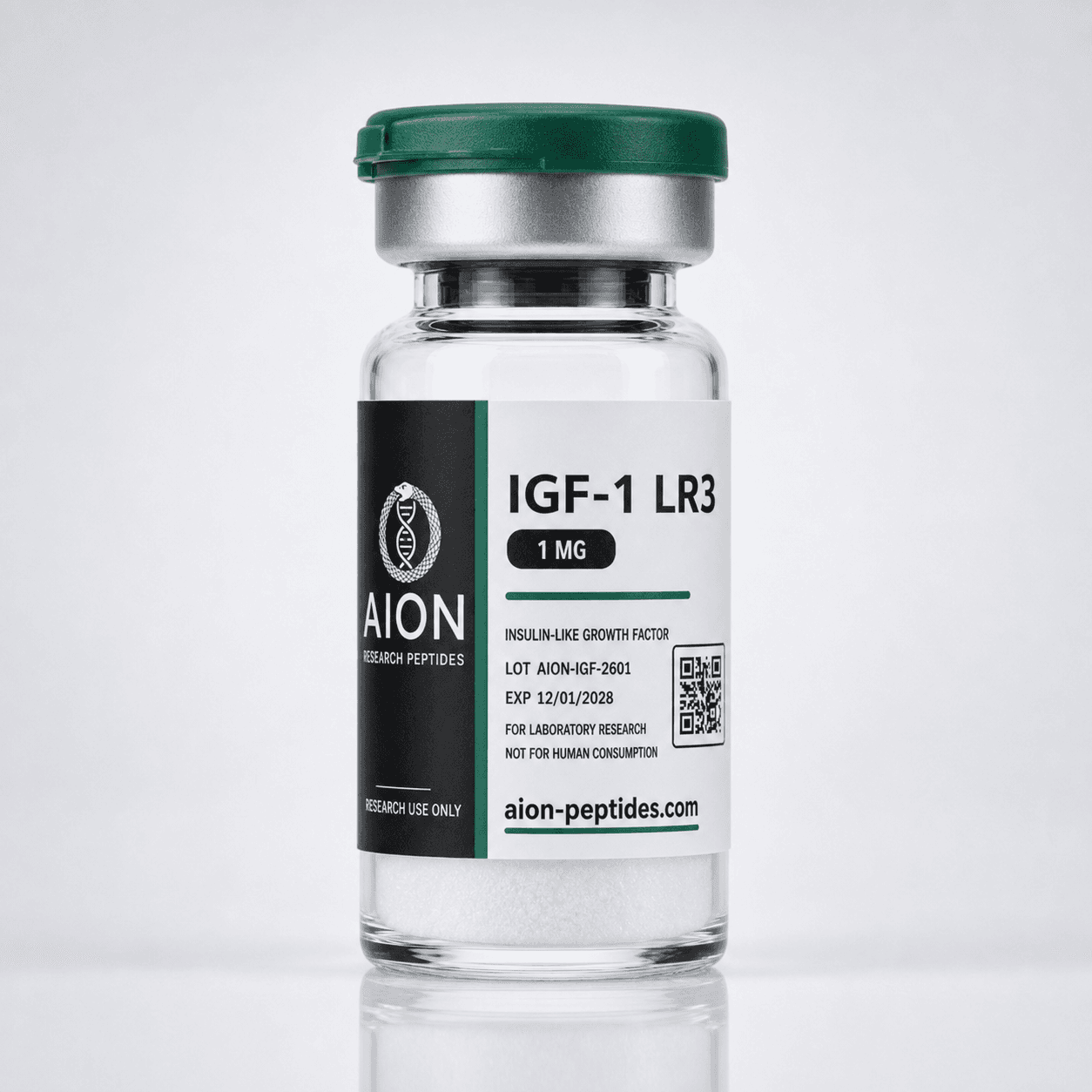
IGF-1 LR3 1mg
IGF-1 LR3 (Long R3) is an 83-amino-acid analogue of human insulin-like growth factor 1, modified by substituting arginine for glutamic acid at position 3 and adding a thirteen-residue N-terminal extension. Both changes reduce its affinity for IGF-binding proteins, which substantially extends its half-life relative to native IGF-1 and is why it is preferred for in-vitro work. Supplied lyophilised. Independently assayed by a third-party laboratory, named on this page; the certificate of analysis for this lot, with its measured purity and batch number, is published on this page. For laboratory research use only.
$110.00
About IGF-1 LR3 in research
IGF-1 LR3 is an 83-residue analogue of human IGF-1 with reduced IGF-binding protein affinity, widely studied as a cell-culture supplement. It consists of the 70-residue human IGF-1 sequence with arginine substituted for glutamic acid at position 3, preceded by a 13-residue N-terminal extension derived from the first eleven residues of methionyl porcine growth hormone plus Val-Asn. It was produced in Escherichia coli as one of a set of fusion analogues by a CSIRO group in Adelaide, who called it Long [Arg3]-IGF-I.
The founding paper by Francis and colleagues compared these analogues with IGF-1 and the truncated form des(1-3)IGF-I. In L6 rat myoblasts all the analogues were more potent than IGF-1 at stimulating protein and DNA synthesis. In cell lines that secrete IGF-binding proteins into the medium, Long [Arg3]-IGF-I and des(1-3)IGF-I were the most potent, while in chicken embryo fibroblasts, which secrete no detectable binding proteins, Long [Arg3]-IGF-I was less potent than IGF-1. The authors attributed the higher potency mainly to weaker binding-protein interactions rather than stronger receptor binding. They also reported that the hydrophobic extension appeared to help the reduced, denatured peptide fold correctly. Laajoki and co-workers later solved its solution structure by NMR: the IGF-1 domain resembles native IGF-1, the main difference being a reorientation of the first three residues of that domain, which they related to the lower binding-protein affinity, and the extension itself was found to be flexible.
Much of the later literature uses the analogue as a defined medium component. Morris and Schmid compared insulin and LongR3 in serum-free cultures of two Chinese hamster ovary (CHO) lines expressing recombinant cytokine receptors, and reported that LongR3 sustained viability under production conditions better than insulin. Becker and colleagues used CHO cells grown with and without LongR3 to validate a 41,000-probe CHO microarray, and described transcriptome changes associated with enhanced growth, delayed cell death and altered cytoskeletal gene expression.
Reproductive biology is a second strand, again in culture. Thomas and colleagues cultured bovine preantral follicles in serum-free medium with LR3 IGF-I or recombinant human IGF-I: both increased follicle diameter and estradiol production, but LR3 IGF-I was associated with smaller oocyte-to-follicle ratios and more oocyte degeneration, and the authors concluded that regulation of IGF bioavailability by binding proteins is needed to coordinate oocyte and follicle development. Araujo and co-workers compared IGF-1 and LongR3-IGF-1 during in vitro maturation of bovine cumulus-oocyte complexes and found no difference in meiotic progression or apoptosis, with differences in a few genes such as IGFBP4 and COX2.
The evidence summarised here is preclinical: biochemical and structural studies, and in vitro work in cell lines, CHO production cultures and bovine follicles and oocytes. In this literature IGF-1 LR3 is mainly a laboratory tool for studying IGF signalling without interference from binding proteins, or for supporting cells in serum-free media.
- Reduced association with IGF-binding proteins, proposed by Francis et al. as the main reason for its higher potency in binding-protein-secreting cell lines.
- Reorientation of the first three residues of the IGF-1 domain, reported in the NMR solution structure and proposed to account for the lower binding-protein affinity.
- Receptor-mediated activity retained despite the extension, reported in cell-line potency assays, including H35 hepatoma cells where IGFs act through the insulin receptor.
- Support of growth and viability in serum-free CHO cultures, reported alongside transcriptome changes in cell-death and cytoskeletal genes.
- Francis GL, Ross M, Ballard FJ, et al. (1992). Novel recombinant fusion protein analogues of insulin-like growth factor (IGF)-I indicate the relative importance of IGF-binding protein and receptor binding for enhanced biological potency. J Mol Endocrinol. [IN VITRO] PubMed record for reference 1, Francis 1992
- Laajoki LG, Francis GL, Wallace JC, et al. (2000). Solution structure and backbone dynamics of long-[Arg(3)]insulin-like growth factor-I. J Biol Chem. [IN VITRO] PubMed record for reference 2, Laajoki 2000
- Morris AE, Schmid J (2000). Effects of insulin and LongR(3) on serum-free Chinese hamster ovary cell cultures expressing two recombinant proteins. Biotechnol Prog. [IN VITRO] PubMed record for reference 3, Morris 2000
- Becker J, Timmermann C, Rupp O, et al. (2014). Transcriptome analyses of CHO cells with the next-generation microarray CHO41K: development and validation by analysing the influence of the growth stimulating substance IGF-1 substitute LongR(3.). J Biotechnol. [IN VITRO] PubMed record for reference 4, Becker 2014
- Thomas FH, Campbell BK, Armstrong DG, et al. (2007). Effects of IGF-I bioavailability on bovine preantral follicular development in vitro. Reproduction. [IN VITRO] PubMed record for reference 5, Thomas 2007
- Araujo MS, Guastali MD, Paulini F, et al. (2020). Molecular and cellular effects of insulin-like growth factor-1 and LongR3-IGF-1 on in vitro maturation of bovine oocytes: comparative study. Growth Horm IGF Res. [IN VITRO] PubMed record for reference 6, Araujo 2020
Identity
- SEQUENCE
- MFPAMPLSSLFVNGPRTLCGAELVDALQFVCGDRGFYFNKPTGYGSSSRRAPQTGIVDECCFRSCDLRRLEMYCAPLKPAKSA (13-residue N-terminal extension MFPAMPLSSLFVN, then human IGF-1 with Arg at position 3)
- MOLECULAR FORMULA
- C400H619N111O115S9
- MOLECULAR WEIGHT
- 9111.5 g/mol
Sequence from Francis et al. (1992) and Laajoki et al. (2000), with the IGF-1 portion from UniProt P05019; formula and weight calculated from that sequence with its three disulfide bonds (PubChem has no compound record for this peptide); checked against the certificate of analysis, lot ABL-IGF-2605.
Storage and handling
- Keep the lyophilised powder sealed, dry and protected from light, typically at -20 °C for long-term storage. Allow the vial to reach room temperature before opening to limit moisture uptake.
- Once in solution, keep at 2–8 °C and use promptly. For longer storage, solutions are typically divided into aliquots and frozen at -20 °C or below, avoiding repeated freeze-thaw. Solution stability has not been established for this lot.
- Suppliers of the cell-culture reagent commonly reconstitute it in dilute acid, typically 10 mM HCl, at up to 1 mg/mL, then dilute into buffer or medium. Add the solvent slowly down the side of the vial and swirl gently rather than shaking. Very dilute solutions are often prepared with a carrier protein such as 0.1% BSA to limit loss to surfaces.
- Adding 1 mL of 10 mM HCl to a 1 mg vial gives a 1 mg/mL stock solution.
Lab testing
Certificate of Analysis
THIRD-PARTY VERIFIED
Purity
98.00%
Lot
ABL-IGF-2605
Formula (corrected)
C400H619N111O115S9
Certificate date
Jun 18, 2026
Laboratory
Vanguard Laboratory
FORMULA CORRECTED The certificate prints C400H625N111O115S9. It counts the six cysteines as free thiols. IGF-1 LR3 has three disulfide bonds; the corrected formula matches the certificate's own molecular weight (9111 g/mol).
TESTS REPORTED Purity (HPLC-UV/VIS) · Heavy metals (ICP-MS) · Endotoxin (LAL) · Microbial limits (USP <61>)
Download Certificate of Analysis (PDF)Lab report issued by Vanguard Laboratory for the sourced batch. For laboratory research use only.
Questions
What is the sequence of IGF-1 LR3?
Eighty-three residues: the 13-residue extension MFPAMPLSSLFVN followed by human IGF-1 with arginine in place of glutamic acid at position 3. With its three disulfide bonds the formula is C400H619N111O115S9 and the average molecular weight about 9111.5 g/mol, calculated from the sequence because PubChem has no compound record for this peptide.
How does IGF-1 LR3 differ from native IGF-1?
Native IGF-1 has 70 residues and binds tightly to IGF-binding proteins. IGF-1 LR3 adds an N-terminal extension and the Arg3 substitution, which together reduce binding-protein affinity. In the original cell-line comparisons this made it more potent than IGF-1 where binding proteins were present, but not where they were absent.
How should IGF-1 LR3 be stored in the lab?
As lyophilised powder, sealed, dry and away from light, typically at -20 °C for long-term storage. Once in solution, keep it at 2–8 °C and use it promptly, or freeze aliquots to avoid repeated freeze-thaw. Solution stability has not been established for this lot.
What does the certificate of analysis test?
The certificate for this lot, issued by Vanguard Laboratory, reports chromatographic purity by HPLC-UV/VIS, heavy metals by ICP-MS, endotoxin by LAL and microbial limits to USP <61>. The measured purity and lot number are shown in the certificate panel on this page.
In which research models has IGF-1 LR3 been studied?
Mainly in vitro: potency assays in rat myoblast, hepatoma and chicken embryo fibroblast cell lines, NMR structural work, serum-free CHO production cultures, and cultured bovine preantral follicles and cumulus-oocyte complexes.
REVIEWED BY DEL POTTER, PHD · OCT 26, 2026
FOR LABORATORY RESEARCH USE ONLY · NOT FOR HUMAN OR ANIMAL USE · MUST BE 21+