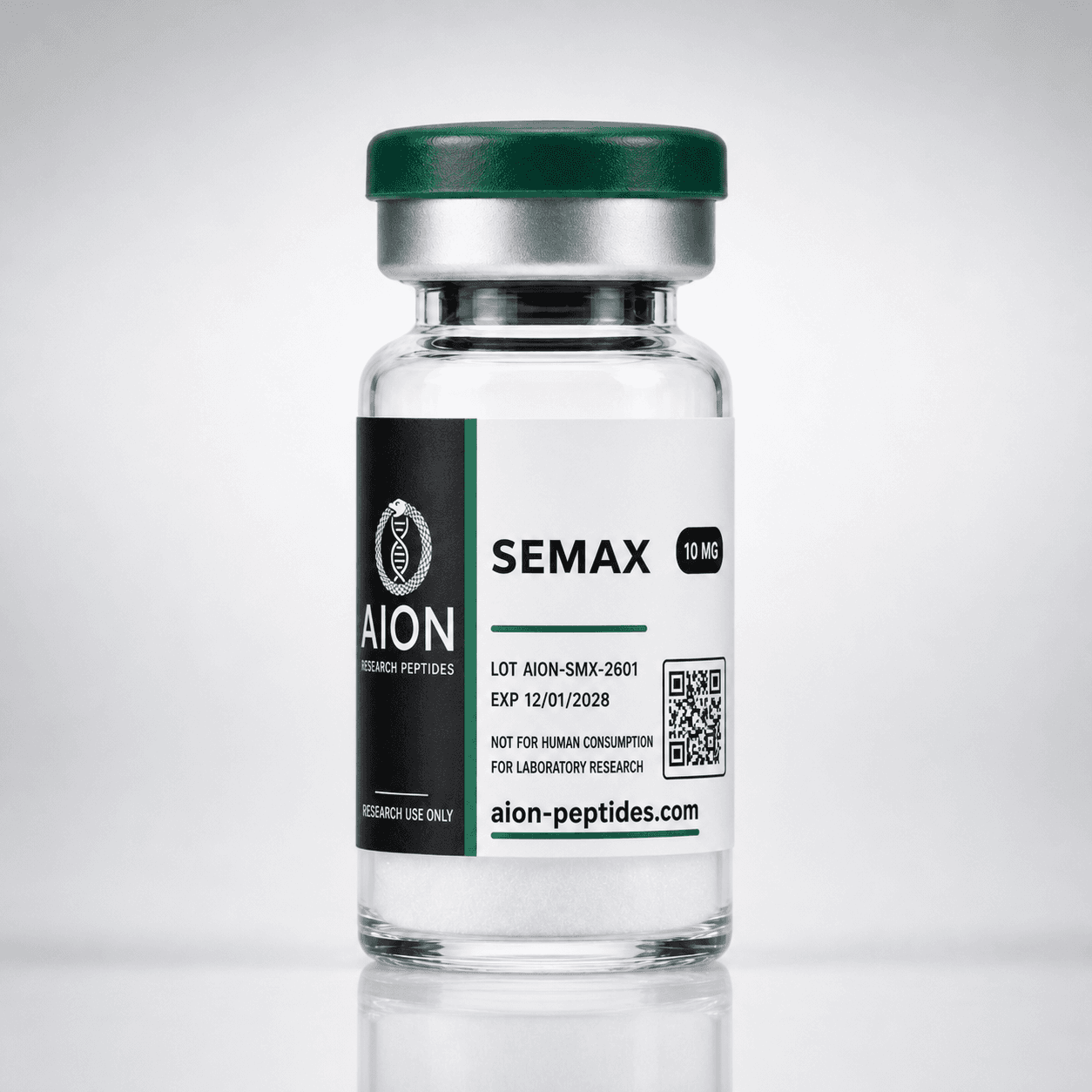
Semax 10mg
Semax is a synthetic heptapeptide based on ACTH(4–7), extended with a proline-glycine-proline tail that resists enzymatic breakdown. Like Selank it came out of the Institute of Molecular Genetics in Moscow. It appears in neuroprotection and BDNF-expression research. Supplied lyophilised. For laboratory research use only.
$45.00
About Semax in research
Semax is a synthetic heptapeptide (Met-Glu-His-Phe-Pro-Gly-Pro) studied in rodent models of cerebral ischaemia and brain neurotrophin gene expression. It joins the ACTH(4-7) fragment, Met-Glu-His-Phe, to a C-terminal Pro-Gly-Pro tripeptide, and the papers below describe it as an analogue of the adrenocorticotropic hormone fragment ACTH(4-10). Most of the published work comes from groups at the Institute of Molecular Genetics of the Russian Academy of Sciences in Moscow, and much of it concerns how the peptide changes gene and protein expression in rat brain tissue.
One line of research concerns brain-derived neurotrophic factor (BDNF) and its receptor TrkB in rats without brain injury. Dolotov and colleagues reported that a single application raised BDNF protein in the rat hippocampus by up to 1.4-fold, with a 1.6-fold increase in TrkB tyrosine phosphorylation and increases in exon III BDNF and TrkB mRNA. Agapova and colleagues measured neurotrophin gene expression by real-time PCR one hour after a single application in male Wistar rats and reported region-specific changes: Bdnf and Ngf expression rose in the hippocampus, Bdnf also rose in the brainstem and cerebellum, and Ngf fell in the frontal cortex.
A second line of research uses rat stroke models. After permanent middle cerebral artery occlusion, Dmitrieva and colleagues reported that Semax increased transcription of Bdnf, TrkC and TrkA in the cortex at 3 hours and of Nt-3 and Ngf at 24 hours. They compared it with the Pro-Gly-Pro tripeptide alone, which had a partly overlapping profile but, by their analysis, a mainly non-specific effect, while Semax acted selectively in ischaemic cortex. A genome-wide study in the same model by Medvedeva and colleagues found that most of the genes whose expression Semax altered were related to the immune system, notably genes for immunoglobulins and chemokines, with a smaller group of vascular-system genes.
Later work moved to RNA sequencing in a transient (ischaemia-reperfusion) occlusion model. Filippenkov and colleagues identified 394 genes differentially expressed at 24 hours in Semax-treated rats relative to saline controls: inflammation-related genes were suppressed and neurotransmission-related genes activated, the reverse of the pattern seen with ischaemia-reperfusion alone. Outside animal models, a cell-free and cell-culture study from Catania reported that Semax prevented the formation of complexes between amyloid beta and copper ions and reduced copper-induced amyloid beta aggregation in artificial membrane models, measured by spectrofluorometric, calorimetric and MTT assays.
The evidence described here is preclinical: rodent gene and protein expression studies, rat ischaemia models and in vitro aggregation assays, concentrated in a small number of research groups. The authors themselves describe the molecular mechanisms as not yet fully understood, so the pathways listed below are proposals drawn from individual models rather than an established account.
- Up-regulation of hippocampal BDNF and increased TrkB phosphorylation, reported in rats without brain injury.
- Region-specific changes in Bdnf and Ngf gene expression, reported in normal rat brain one hour after a single application.
- Increased transcription of neurotrophins and their Trk receptors in ischaemic cortex, reported after permanent middle cerebral artery occlusion in rats.
- Modulation of immune-response and vascular-system genes, and suppression of inflammation-related transcripts, proposed from transcriptome studies in rat focal ischaemia and ischaemia-reperfusion models.
- Inhibition of copper-induced amyloid beta aggregation, reported in vitro in artificial membrane models.
- Dolotov OV, Karpenko EA, et al. (2006). Semax, an analog of ACTH(4-10) with cognitive effects, regulates BDNF and trkB expression in the rat hippocampus. Brain Res. [RODENT] PubMed record for reference 1, Dolotov 2006
- Agapova TY, Agniullin YV, et al. (2007). Neurotrophin gene expression in rat brain under the action of Semax, an analogue of ACTH 4-10. Neurosci Lett. [RODENT] PubMed record for reference 2, Agapova 2007
- Dmitrieva VG, Povarova OV, et al. (2010). Semax and Pro-Gly-Pro activate the transcription of neurotrophins and their receptor genes after cerebral ischemia. Cell Mol Neurobiol. [RODENT] PubMed record for reference 3, Dmitrieva 2010
- Medvedeva EV, Dmitrieva VG, et al. (2014). The peptide semax affects the expression of genes related to the immune and vascular systems in rat brain focal ischemia: genome-wide transcriptional analysis. BMC Genomics. [RODENT] PubMed record for reference 4, Medvedeva 2014
- Filippenkov IB, Stavchansky VV, et al. (2020). Novel Insights into the Protective Properties of ACTH((4-7))PGP (Semax) Peptide at the Transcriptome Level Following Cerebral Ischaemia-Reperfusion in Rats. Genes (Basel). [RODENT] PubMed record for reference 5, Filippenkov 2020
- Sciacca MFM, Naletova I, et al. (2022). Semax, a Synthetic Regulatory Peptide, Affects Copper-Induced Abeta Aggregation and Amyloid Formation in Artificial Membrane Models. ACS Chem Neurosci. [IN VITRO] PubMed record for reference 6, Sciacca 2022
Identity
- SEQUENCE
- MEHFPGP (Met-Glu-His-Phe-Pro-Gly-Pro)
- MOLECULAR FORMULA
- C37H51N9O10S
- MOLECULAR WEIGHT
- 813.9 g/mol
- CAS NUMBER
- 80714-61-0
- PUBCHEM CID
- 9811102
Sequence, formula, weight and CAS from PubChem (CID 9811102), with the formula and weight recomputed from the sequence; CAS also matches the certificate of analysis, lot 20250510, which names Semax but gives no formula or mass.
Storage and handling
- Keep the lyophilised powder sealed, dry and protected from light, typically at -20 °C or below for long-term storage. Allow the vial to reach room temperature before opening to limit moisture uptake.
- Once in solution, keep at 2–8 °C and use promptly. For longer storage, solutions are typically divided into aliquots and frozen at -20 °C or below, avoiding repeated freeze-thaw. Solution stability has not been established for this lot.
- The certificate for this lot reports the material fully soluble in deionised water to a clear, particle-free solution. Add the solvent slowly down the side of the vial and swirl gently rather than shaking.
- Adding 10 mL of sterile water to a 10 mg vial gives a 1 mg/mL stock solution.
Lab testing
Certificate of Analysis
THIRD-PARTY VERIFIED
Purity
99.75%
Lot
20250510
Certificate date
Jun 4, 2026
Laboratory
North South Precision Testing
TESTS REPORTED Purity · Impurities · Heavy metals (Pb, Cd, Hg, As) · Moisture, pH, solubility
Download Certificate of Analysis (PDF)Lab report issued by North South Precision Testing for the sourced batch. For laboratory research use only.
Questions
What is the amino acid sequence of Semax?
MEHFPGP: Met-Glu-His-Phe-Pro-Gly-Pro, seven residues. PubChem (CID 9811102) gives the formula C37H51N9O10S and a molecular weight of 813.9 g/mol, and lists CAS 80714-61-0, the same CAS stated on the certificate.
How does Semax differ from ACTH(4-10) and from Pro-Gly-Pro?
Semax keeps the ACTH(4-7) segment, Met-Glu-His-Phe, and replaces the rest of the ACTH(4-10) fragment with a Pro-Gly-Pro tripeptide, which is why papers call it an ACTH(4-10) analogue. Pro-Gly-Pro has also been studied on its own: in a rat stroke model it changed neurotrophin gene transcription in a partly overlapping pattern, which the authors judged mainly non-specific, while the effect of Semax was selective for ischaemic cortex.
How should Semax be stored in the lab?
As lyophilised powder, sealed, dry and away from light, typically at -20 °C or below for long-term storage. Once in solution, keep it at 2–8 °C and use it promptly, or freeze aliquots to avoid repeated freeze-thaw.
What does the certificate of analysis test?
The certificate for this lot, issued by North South Precision Testing, reports appearance, purity, impurities, moisture content, pH, solubility, residual solvents and heavy metals (Pb, Cd, Hg, As). It names the compound and its CAS number but does not report a mass-spectrometry identity check. The measured purity and lot number are shown in the certificate panel on this page.
In which research models has Semax been studied?
Mostly in rats: neurotrophin gene and protein expression in the hippocampus and other regions of the uninjured brain, and gene-expression studies after permanent or transient middle cerebral artery occlusion. In vitro work includes amyloid beta aggregation assays in artificial membrane models. Most of the studies come from a small number of Russian research groups.
REVIEWED BY DEL POTTER, PHD · OCT 26, 2026
FOR LABORATORY RESEARCH USE ONLY · NOT FOR HUMAN OR ANIMAL USE · MUST BE 21+