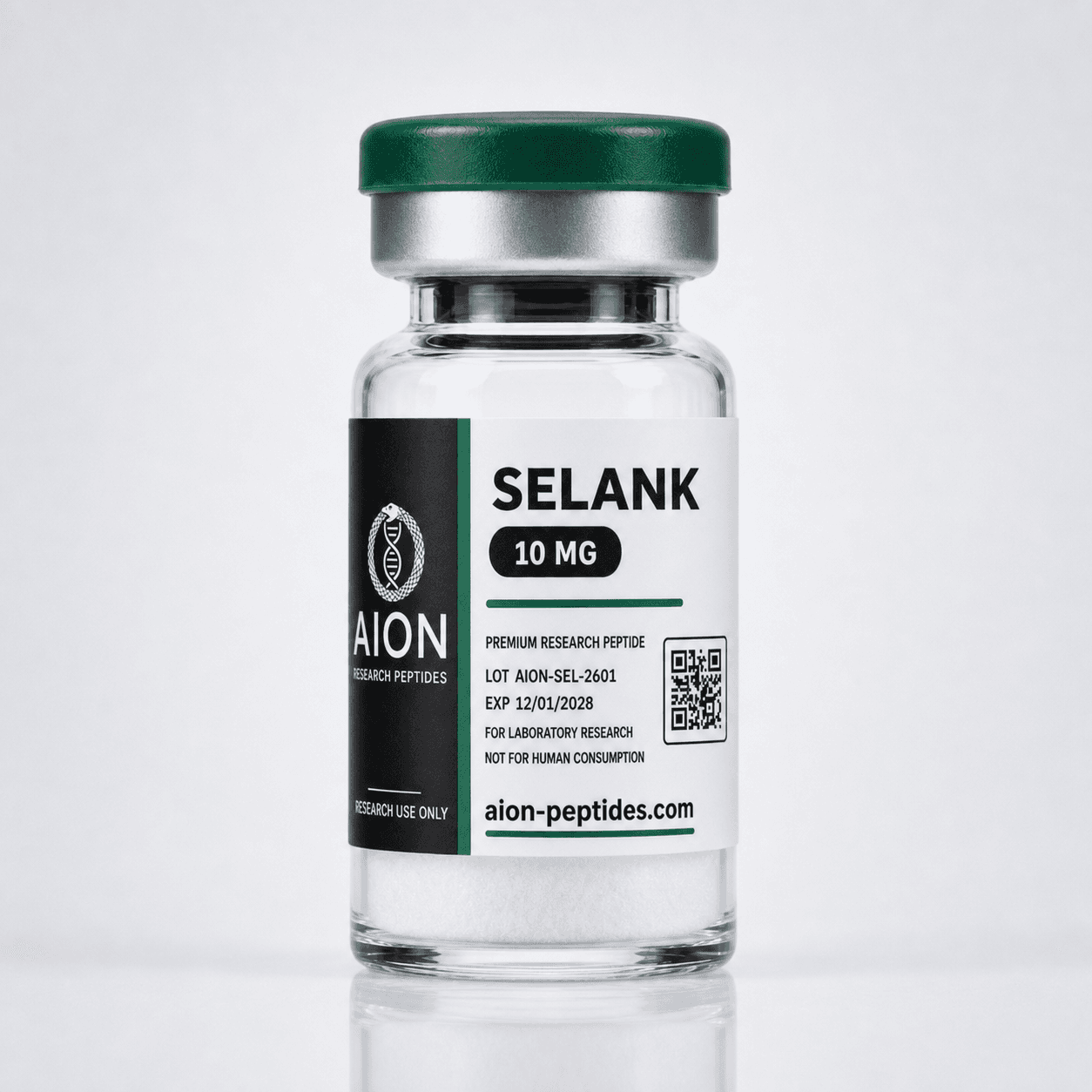
Selank 10mg
Selank is a synthetic heptapeptide developed at the Institute of Molecular Genetics in Moscow as a stabilised analogue of tuftsin, an endogenous immunomodulatory tetrapeptide. The three additional residues extend its half-life relative to tuftsin itself. It appears in neuropeptide research concerning anxiolytic mechanisms, BDNF expression and immune signalling. Supplied lyophilised. Independently assayed by a third-party laboratory, named on this page; the certificate of analysis for this lot, with its measured purity and batch number, is published on this page. For laboratory research use only.
$85.00
About Selank in research
Selank is a synthetic heptapeptide analogue of tuftsin, studied mainly in rodent anxiety-like behaviour models and in brain and immune gene-expression studies. Its sequence is Thr-Lys-Pro-Arg-Pro-Gly-Pro. The first four residues are tuftsin itself, a Thr-Lys-Pro-Arg fragment of the human immunoglobulin G heavy chain, and the C-terminal Pro-Gly-Pro was added to improve metabolic stability. The peptide was designed at the Institute of Molecular Genetics of the Russian Academy of Sciences together with the V.V. Zakusov Research Institute of Pharmacology, and most of the published work comes from Moscow groups.
Much of the mechanistic literature concerns the GABAergic system. In radioligand binding experiments on brain cell membrane preparations, Vyunova and colleagues reported that Selank changed [3H]GABA binding in a way consistent with positive allosteric modulation, and that it blocked the modulatory activity of diazepam and olanzapine in the same assay; they proposed that its binding site differs from theirs but may partly overlap. Volkova and colleagues measured 84 neurotransmission-related genes in rat frontal cortex and found 45 with changed expression 1 hour after Selank or GABA, and 22 after 3 hours, with the changes after the two compounds positively correlated. A few genes, including the dopamine receptor genes Drd1a and Drd2, changed only after Selank. In human neuroblastoma IMR-32 cells, by contrast, Selank alone changed none of the 84 genes studied; combined with GABA, it almost completely suppressed the expression changes that GABA produced on its own, and combined with olanzapine it was associated with changes in more genes than olanzapine alone.
Behavioural studies use rodent anxiety-like behaviour models. Kasian and colleagues used the elevated plus maze in rats with and without unpredictable chronic mild stress, giving Selank and diazepam separately and together. Without stress, a course of either compound shifted anxiety-related measures, with smaller shifts after Selank; under chronic stress, measures in rats given both compounds did not differ from their values before stress. A separate strand concerns immune gene expression. In mouse spleen, Kolomin and colleagues reported changes in 34 of 84 inflammation-related genes, including chemokine and cytokine genes, 6 and 24 hours after a single treatment with Selank or either of two of its fragments, with the Bcl6 gene changing in response to each peptide.
The Moscow group's papers refer to clinical studies in Russia, and a 2021 review by Doyno and White at the University of Connecticut describes Selank as a poorly studied Russian drug with GABAergic mechanisms. The evidence summarised on this page is preclinical: rodent behaviour and gene-expression studies, a human cell line and membrane binding assays, nearly all from a small number of closely connected Moscow research groups. The pathways listed below are proposals from individual models rather than a settled account.
- Positive allosteric modulation of GABA-A receptor binding, proposed from [3H]GABA binding assays in brain membrane preparations.
- Changes in the expression of GABAergic and other neurotransmission genes, including Drd1a and Drd2, reported in rat frontal cortex.
- Modulation of GABA-induced gene-expression changes, without direct effects of Selank alone, reported in human neuroblastoma IMR-32 cells.
- Altered expression of inflammation-related genes, including Bcl6 and its targets, reported in mouse spleen.
- Vyunova TV, Andreeva L, Shevchenko K, et al. (2018). Peptide-based Anxiolytics: The Molecular Aspects of Heptapeptide Selank Biological Activity. Protein Pept Lett. [IN VITRO] PubMed record for reference 1, Vyunova 2018
- Volkova A, Shadrina M, Kolomin T, et al. (2016). Selank Administration Affects the Expression of Some Genes Involved in GABAergic Neurotransmission. Front Pharmacol. [RODENT] PubMed record for reference 2, Volkova 2016
- Filatova E, Kasian A, Kolomin T, et al. (2017). GABA, Selank, and Olanzapine Affect the Expression of Genes Involved in GABAergic Neurotransmission in IMR-32 Cells. Front Pharmacol. [IN VITRO] PubMed record for reference 3, Filatova 2017
- Kasian A, Kolomin T, Andreeva L, et al. (2017). Peptide Selank Enhances the Effect of Diazepam in Reducing Anxiety in Unpredictable Chronic Mild Stress Conditions in Rats. Behav Neurol. [RODENT] PubMed record for reference 4, Kasian 2017
- Kolomin T, Shadrina M, Andreeva L, et al. (2011). Expression of inflammation-related genes in mouse spleen under tuftsin analog Selank. Regul Pept. [RODENT] PubMed record for reference 5, Kolomin 2011
- Doyno CR, White CM (2021). Sedative-Hypnotic Agents That Impact Gamma-Aminobutyric Acid Receptors: Focus on Flunitrazepam, Gamma-Hydroxybutyric Acid, Phenibut, and Selank. J Clin Pharmacol. [REVIEW] PubMed record for reference 6, Doyno 2021
Identity
- SEQUENCE
- TKPRPGP (Thr-Lys-Pro-Arg-Pro-Gly-Pro)
- MOLECULAR FORMULA
- C33H57N11O9
- MOLECULAR WEIGHT
- 751.9 g/mol
- CAS NUMBER
- 129954-34-3
- PUBCHEM CID
- 11765600
Formula and weight from PubChem (CID 11765600); CAS from PubChem's ChemIDplus record; sequence from PubChem and Volkova et al. (2016); checked against the certificate of analysis, lot ABL-SEL-2605.
Storage and handling
- Keep the lyophilised powder sealed, dry and protected from light, typically at -20 °C for long-term storage. Allow the vial to reach room temperature before opening to limit moisture uptake.
- Once in solution, keep at 2–8 °C and use promptly. For longer storage, solutions are typically divided into aliquots and frozen at -20 °C or below, avoiding repeated freeze-thaw. Solution stability has not been established for this lot.
- Generally soluble in sterile water and common aqueous buffers; one published rat study prepared Selank diacetate in deionised water at 10 mg/mL. Add the solvent slowly down the side of the vial and swirl gently rather than shaking.
- Adding 2 mL of sterile water to a 10 mg vial gives a 5 mg/mL stock solution.
Lab testing
Certificate of Analysis
THIRD-PARTY VERIFIED
Purity
>99.80%
Lot
ABL-SEL-2605
Formula
C33H57N11O9
Certificate date
Jun 18, 2026
Laboratory
Vanguard Laboratory
TESTS REPORTED Purity (HPLC-UV/VIS) · Heavy metals (ICP-MS) · Endotoxin (LAL) · Microbial limits (USP <61>)
Download Certificate of Analysis (PDF)Lab report issued by Vanguard Laboratory for the sourced batch. For laboratory research use only.
Questions
What is the amino acid sequence of Selank?
TKPRPGP: Thr-Lys-Pro-Arg-Pro-Gly-Pro, seven residues. PubChem (CID 11765600) gives the formula C33H57N11O9 and a molecular weight of 751.9 g/mol, and lists CAS 129954-34-3.
How does Selank differ from tuftsin?
Tuftsin is the tetrapeptide Thr-Lys-Pro-Arg, a fragment of the human immunoglobulin G heavy chain. Selank keeps those four residues and adds Pro-Gly-Pro at the C-terminus, an extension its developers describe as improving metabolic stability.
How should Selank be stored in the lab?
As lyophilised powder, sealed, dry and away from light, typically at -20 °C for long-term storage. Once in solution, keep it at 2–8 °C and use it promptly, or freeze aliquots to avoid repeated freeze-thaw. Solution stability has not been established for this lot.
What does the certificate of analysis test?
The certificate for this lot, issued by Vanguard Laboratory, reports purity by HPLC-UV/VIS, heavy metals by ICP-MS, endotoxin by LAL and microbial limits under USP <61>, along with the measured content of three vials. It does not include a mass-spectrometry identity test. The measured purity and lot number are shown in the certificate panel on this page.
In which research models has Selank been studied?
Mostly in rodents: the elevated plus maze in rats under unpredictable chronic mild stress, gene-expression studies in rat frontal cortex and inflammation-related gene studies in mouse spleen. Cell and tissue work includes human neuroblastoma IMR-32 cells and [3H]GABA binding assays in brain membrane preparations. Most of the work comes from a few research groups in Moscow.
REVIEWED BY DEL POTTER, PHD · OCT 26, 2026
FOR LABORATORY RESEARCH USE ONLY · NOT FOR HUMAN OR ANIMAL USE · MUST BE 21+