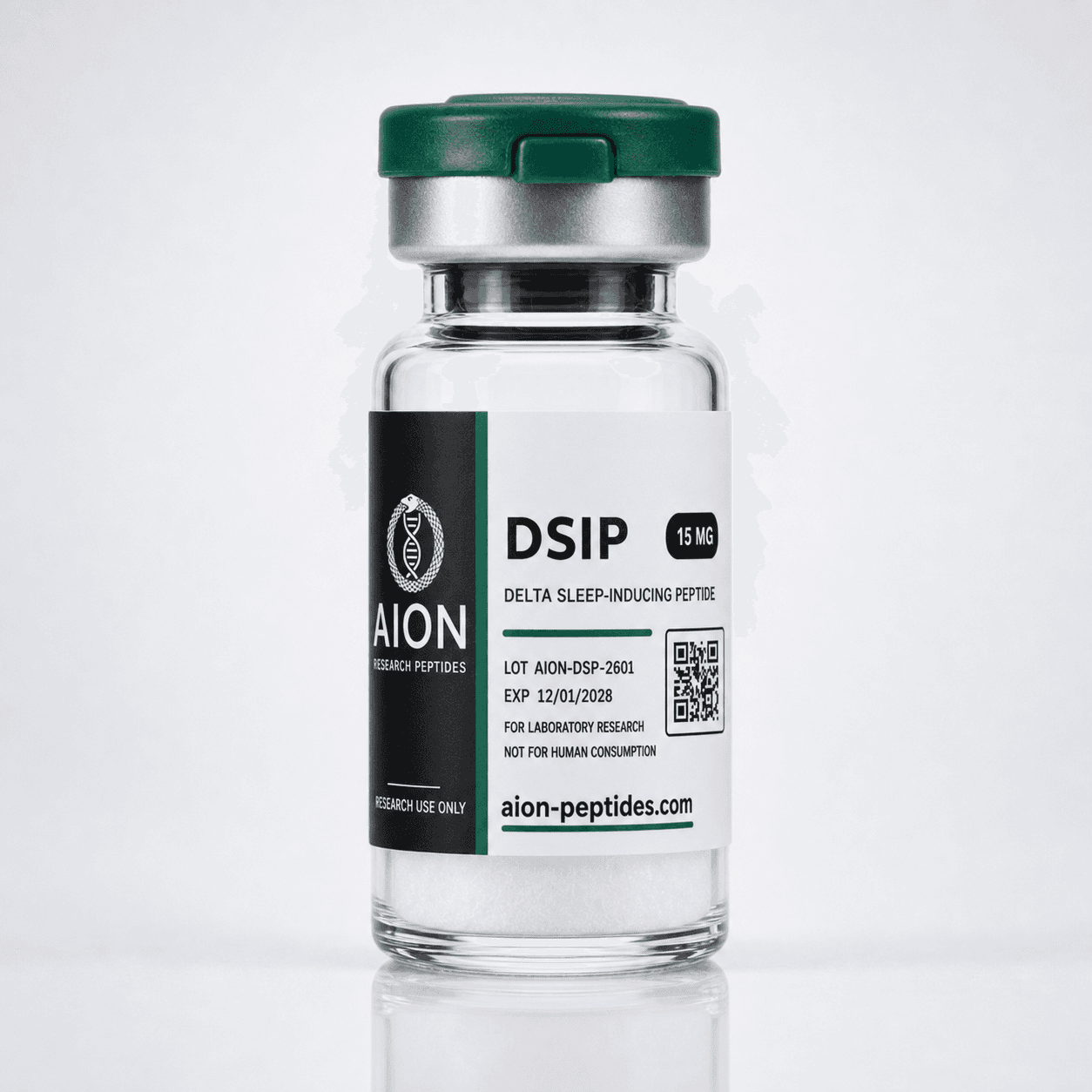
DSIP - 15mg
DSIP — delta sleep-inducing peptide — is a nonapeptide first isolated in 1977 from the cerebral venous blood of rabbits during induced slow-wave sleep, which is how it acquired its name. It crosses the blood-brain barrier readily for a peptide of its size, and appears in chronobiology and neuroendocrine research. Supplied lyophilised. For laboratory research use only.
$79.99
About DSIP in research
DSIP (delta sleep-inducing peptide) is a nonapeptide, WAGGDASGE, studied in rabbit and rat EEG sleep models and in rodent stress and endocrine research. It was isolated from rabbits by Schoenenberger and Monnier in Basel, who reported in 1977 that the synthetic nonapeptide, delivered into the brain ventricles under double-blind conditions, enhanced delta (slow-wave) and spindle EEG patterns in rabbits. In the same study, five possible fragments of the peptide, two analogues with exchanged residues and a related tripeptide did not show that specific effect.
The later record is mixed. A 1984 review by Graf and Kastin collected reports of delta sleep enhancement in rabbits, rats and mice, a U-shaped activity curve, and DSIP-like material detected by radioimmunoassay and immunohistochemistry in rat brain and peripheral organs and in the plasma of several mammals. The same review lists reported effects beyond sleep: on electrophysiological activity, brain neurotransmitter levels, circadian and locomotor patterns and hormone levels. Not every laboratory reproduced the sleep effect. In a 1986 study in rats recorded across a full dark and light period, Obál, Kovalzon and colleagues found that DSIP itself did not increase sleep, while two analogues with a D-amino acid at position 1, [D-Trp1]-DSIP and [D-Tyr1]-DSIP, promoted sleep early in the dark period and a shortened analogue had an arousing effect. The authors suggested that DSIP is degraded too quickly to act.
A second strand concerns stress and endocrine signalling in rats. Graf and Schoenenberger reported that DSIP enhanced norepinephrine-stimulated N-acetyltransferase activity in rat pineal glands in vitro, and that the alpha-1 adrenergic blocker prazosin eliminated the enhancement; they concluded that the peptide modulates the alpha-1 adrenergic response, while noting that no earlier proposed mechanism had convincing evidence behind it. Umriukhin and colleagues studied Wistar rats grouped by predicted resistance to emotional stress: DSIP reduced the number of Fos-immunoreactive cells in the parvocellular paraventricular nucleus of the hypothalamus after immobilisation, the NMDA-receptor blocker MK-801 prevented this in stress-predisposed rats, and cycloheximide prevented it in stress-resistant rats. The authors proposed that the effect might be mediated by NMDA receptors.
What DSIP does, and whether it is a natural signalling molecule at all, remains unresolved. In a 2006 review titled "a still unresolved riddle", Kovalzon and Strekalova wrote that the link between DSIP and sleep was never further characterised, in part because no DSIP gene, precursor protein or receptor has been isolated, and that the hypothesis of DSIP as a sleep factor is extremely poorly documented. In their own rabbit and rat studies, slow-wave sleep promotion was seen with certain synthetic analogues but not with DSIP itself, and they proposed that a structurally related DSIP-like peptide may account for the immunoreactivity and activity attributed to DSIP.
The evidence is preclinical and inconsistent: rabbit and rat EEG sleep studies, rat stress and endocrine models, and tissue preparations in vitro, with findings that differ between laboratories. No receptor or gene for DSIP has been confirmed, so the mechanisms below are proposals from individual models rather than an established account.
- Modulation of alpha-1 adrenergic responses, proposed from norepinephrine-stimulated N-acetyltransferase activity in rat pineal glands in vitro, which prazosin abolished.
- NMDA-receptor involvement, proposed from the suppression of immobilisation-induced c-Fos expression in the rat hypothalamic paraventricular nucleus, which MK-801 prevented in stress-predisposed rats.
- Rapid degradation, proposed to explain why DSIP did not increase sleep in rats while D-amino acid analogues at position 1 did.
- A related endogenous DSIP-like peptide, proposed in a 2006 review to account for DSIP-like immunoreactivity and activity; no DSIP receptor or gene has been confirmed.
- Schoenenberger GA, Monnier M (1977). Characterization of a delta-electroencephalogram (-sleep)-inducing peptide. Proc Natl Acad Sci U S A. [OTHER ANIMAL] PubMed record for reference 1, Schoenenberger 1977
- Graf MV, Kastin AJ (1984). Delta-sleep-inducing peptide (DSIP): a review. Neurosci Biobehav Rev. [REVIEW] PubMed record for reference 2, Graf 1984
- Obál F Jr, Kovalzon VM, Kalikhevich VN, et al. (1986). Structure-activity relationship in the effects of delta-sleep-inducing peptide (DSIP) on rat sleep. Pharmacol Biochem Behav. [RODENT] PubMed record for reference 3, Obál 1986
- Graf MV, Schoenenberger GA (1987). Delta sleep-inducing peptide modulates the stimulation of rat pineal N-acetyltransferase activity by involving the alpha 1-adrenergic receptor. J Neurochem. [IN VITRO] PubMed record for reference 4, Graf 1987
- Umriukhin PE, Koplik EV, Sudakov KV (2012). Dizocilpine and cycloheximide prevent inhibition of c-Fos gene expression by delta sleep-inducing peptide in the paraventricular nucleus of the hypothalamus in rats with different resistance to emotional stress. Neurosci Lett. [RODENT] PubMed record for reference 5, Umriukhin 2012
- Kovalzon VM, Strekalova TV (2006). Delta sleep-inducing peptide (DSIP): a still unresolved riddle. J Neurochem. [REVIEW] PubMed record for reference 6, Kovalzon 2006
Identity
- SEQUENCE
- WAGGDASGE (Trp-Ala-Gly-Gly-Asp-Ala-Ser-Gly-Glu)
- MOLECULAR FORMULA
- C35H48N10O15
- MOLECULAR WEIGHT
- 848.8 g/mol
- CAS NUMBER
- 62568-57-4
- PUBCHEM CID
- 68816
Formula, weight and CAS from PubChem (CID 68816); sequence from Schoenenberger and Monnier (1977) and the PubChem structure. No certificate of analysis has been published for this product yet, so these figures are not from a test of this product.
Storage and handling
- Keep the lyophilised powder sealed, dry and protected from light, typically at -20 °C for long-term storage. Allow the vial to reach room temperature before opening to limit moisture uptake.
- Once in solution, keep at 2–8 °C and use promptly. For longer storage, solutions are typically divided into aliquots and frozen at -20 °C or below, avoiding repeated freeze-thaw. Solution stability has not been established for this product.
- Generally soluble in sterile water and common aqueous buffers. Add the solvent slowly down the side of the vial and swirl gently rather than shaking.
- Adding 3 mL of sterile water to a 15 mg vial gives a 5 mg/mL stock solution.
Lab testing
Certificate of Analysis
No certificate of analysis is published for this product yet. Where a certificate exists we publish it in full, as issued by the laboratory — the measured purity, the lot number and the date of analysis, not a summary written by us.
Certificates are being obtained for the remainder of the catalogue.
Questions
What is the amino acid sequence of DSIP?
WAGGDASGE: Trp-Ala-Gly-Gly-Asp-Ala-Ser-Gly-Glu, nine residues, as reported by Schoenenberger and Monnier in 1977. PubChem (CID 68816) gives the formula C35H48N10O15 and a molecular weight of 848.8 g/mol, and lists CAS 62568-57-4.
How does DSIP differ from its synthetic analogues?
The analogues studied alongside it change the peptide at specific positions, for example [D-Trp1]-DSIP and [D-Tyr1]-DSIP, which carry a D-amino acid at position 1, or shortened fragments. In a rat sleep study the two D-amino acid analogues promoted sleep while DSIP itself did not, and a 2006 review reports the same pattern in rabbits and rats. This product is the unmodified nonapeptide.
How should DSIP be stored in the lab?
As lyophilised powder, sealed, dry and away from light, typically at -20 °C for long-term storage. Once in solution, keep it at 2–8 °C and use it promptly, or freeze aliquots to avoid repeated freeze-thaw.
Is there a certificate of analysis for DSIP?
Not yet. No certificate of analysis has been published for this product, and the COA library at /coa lists it as in progress. The identity figures on this page come from PubChem and the published sequence, not from a test of this product.
In which research models has DSIP been studied?
It has been studied in rabbit and rat EEG sleep models, in rat stress models such as immobilisation with c-Fos mapping in the hypothalamus, and in rat pineal gland preparations in vitro. Findings differ between laboratories, and reviews note that no DSIP receptor or gene has been confirmed.
REVIEWED BY DEL POTTER, PHD · OCT 26, 2026
FOR LABORATORY RESEARCH USE ONLY · NOT FOR HUMAN OR ANIMAL USE · MUST BE 21+