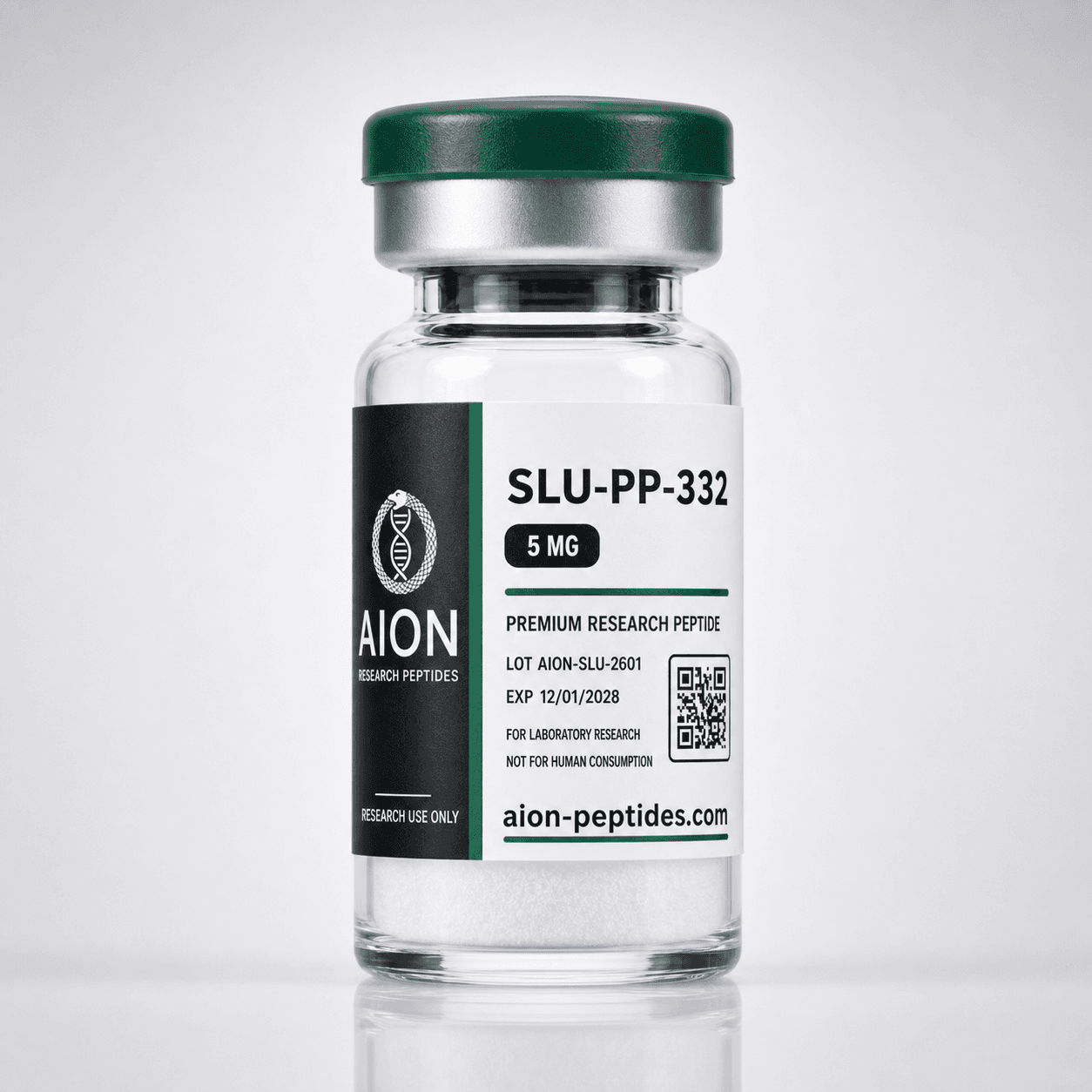
SLU-PP-332 5mg
SLU-PP-332 is not a peptide but a small-molecule agonist of the estrogen-related receptors, developed at Saint Louis University. It appears in exercise-mimetic and mitochondrial-biogenesis research, where ERR activation is studied as a route to the transcriptional changes normally associated with endurance training. Supplied lyophilised. For laboratory research use only.
$100.00
About SLU-PP-332 in research
SLU-PP-332 is a small-molecule agonist of the estrogen-related receptors ERRα, ERRβ and ERRγ, studied in mouse skeletal muscle, metabolic and cardiac models. It is not a peptide: it is an aryl hydrazone, 4-hydroxy-N'-(naphthalen-2-ylmethylene)benzohydrazide, with the formula C18H14N2O2. It was described as a pan-ERR agonist by Billon and colleagues, working at Saint Louis University and collaborating institutions, who reported that it acts on all three ERR subtypes with the highest potency at ERRα and has pharmacokinetic properties that allowed its use as an in vivo chemical tool in mice.
The first study concerned skeletal muscle. In a skeletal muscle cell line, Billon and colleagues reported increased mitochondrial function and cellular respiration. In mice, they reported an increase in type IIa oxidative muscle fibres and increased running endurance, together with induction of a gene expression programme resembling the acute response to aerobic exercise. The authors reported that this programme depended on ERRα, and that ERRα activation was needed for the endurance effect they observed in mice.
A follow-up study by the same group examined SLU-PP-332 in mouse models of diet-induced obesity and in ob/ob mice. The authors reported increased whole-body energy expenditure and fatty acid oxidation, less fat mass accumulation, and improved insulin sensitivity in these models. A separate collaboration examined SLU-PP-332, alongside a structurally distinct pan-ERR agonist, SLU-PP-915, in a mouse model of pressure overload-induced heart failure. There both compounds were reported to improve ejection fraction and reduce fibrosis without affecting cardiac hypertrophy, with transcriptional activation of fatty acid metabolism and mitochondrial genes; genetic dependency experiments identified ERRγ as the main mediator in heart tissue.
Other groups have used SLU-PP-332 as a tool compound. In a study of kidney function in 21-month-old mice, Wang and colleagues reported that eight weeks of treatment with the agonist reversed increases in albuminuria, podocyte loss, mitochondrial dysfunction and inflammatory cytokines seen in the aged animals, and linked these changes to cGAS-STING and STAT3 signalling. Analytical work has also begun: Möller, Krug and Thevis characterised SLU-PP-332 by liquid chromatography-high resolution mass spectrometry and identified nine metabolites, six phase I and three phase II, after incubation with human liver S9 fraction and microsomes.
The evidence base is preclinical. The in vivo findings come from mouse models, much of it from one research group and its collaborators, and the human data are limited to in vitro metabolism by liver fractions. No clinical studies of SLU-PP-332 have been reported, so the pathways listed below are proposals from individual models rather than a settled account.
- Agonism at ERRα, ERRβ and ERRγ, proposed as the primary mechanism, with the highest potency at ERRα reported in the original characterisation.
- Increased mitochondrial function and cellular respiration, reported in a skeletal muscle cell line.
- Induction of an ERRα-dependent gene programme resembling the acute aerobic exercise response, with more type IIa oxidative fibres, reported in mouse skeletal muscle.
- Increased energy expenditure and fatty acid oxidation, reported in diet-induced obese and ob/ob mice.
- ERRγ-mediated activation of fatty acid metabolism and mitochondrial genes, reported in a mouse pressure-overload heart failure model.
- Billon C, Sitaula S, Banerjee S, et al. (2023). Synthetic ERRα/β/γ Agonist Induces an ERRα-Dependent Acute Aerobic Exercise Response and Enhances Exercise Capacity. ACS Chem Biol. [RODENT] PubMed record for reference 1, Billon 2023
- Billon C, Schoepke E, Avdagic A, et al. (2024). A Synthetic ERR Agonist Alleviates Metabolic Syndrome. J Pharmacol Exp Ther. [RODENT] PubMed record for reference 2, Billon 2024
- Xu W, Billon C, Li H, et al. (2024). Novel Pan-ERR Agonists Ameliorate Heart Failure Through Enhancing Cardiac Fatty Acid Metabolism and Mitochondrial Function. Circulation. [RODENT] PubMed record for reference 3, Xu 2024
- Wang XX, Myakala K, Libby AE, et al. (2023). Estrogen-Related Receptor Agonism Reverses Mitochondrial Dysfunction and Inflammation in the Aging Kidney. Am J Pathol. [RODENT] PubMed record for reference 4, Wang 2023
- Möller T, Krug O, Thevis M (2026). In Vitro Metabolism and Analytical Characterization of SLU-PP-332 and SLU-PP-915: Novel Pan-ERR Agonists With Doping Potential. Rapid Commun Mass Spectrom. [IN VITRO] PubMed record for reference 5, Möller 2026
Identity
- MOLECULAR FORMULA
- C18H14N2O2
- MOLECULAR WEIGHT
- 290.3 g/mol
- CAS NUMBER
- 303760-60-3
- PUBCHEM CID
- 5338394
Formula, weight and CAS from PubChem (CID 5338394); a certificate of analysis has not yet been published for this product, so these figures are not yet checked against a certificate.
Storage and handling
- Keep the dry powder sealed, dry and protected from light, typically at -20 °C for long-term storage. Allow the vial to reach room temperature before opening to limit moisture uptake.
- Stock solutions in DMSO are typically divided into aliquots and kept frozen at -20 °C or below, protected from light and avoiding repeated freeze-thaw. Solution stability has not been established for this lot.
- Poorly soluble in water. A supplier datasheet reports good solubility in anhydrous DMSO and limited solubility in ethanol; moisture in the DMSO can reduce solubility. Aqueous working solutions are usually made by diluting a DMSO stock into buffer.
- Adding 1 mL of anhydrous DMSO to a 5 mg vial gives a 5 mg/mL stock solution (about 17 mM).
Lab testing
Certificate of Analysis
No certificate of analysis is published for this product yet. Where a certificate exists we publish it in full, as issued by the laboratory — the measured purity, the lot number and the date of analysis, not a summary written by us.
Certificates are being obtained for the remainder of the catalogue.
Questions
Is SLU-PP-332 a peptide, and what is its structure?
No. SLU-PP-332 is a small molecule with no amino acid sequence: 4-hydroxy-N'-(naphthalen-2-ylmethylene)benzohydrazide. PubChem (CID 5338394) gives the formula C18H14N2O2 and a molecular weight of 290.3 g/mol, and lists CAS 303760-60-3.
How does SLU-PP-332 differ from SLU-PP-915?
Both are pan-ERR agonists from the same research programme, but they are structurally distinct compounds. SLU-PP-332 is the earlier one, reported with the highest potency at ERRα. The two were compared in a mouse heart failure model, and an in vitro study found different metabolite profiles: phase I and phase II metabolites for SLU-PP-332, phase I products only for SLU-PP-915.
How should SLU-PP-332 be stored in the lab?
As a dry powder, sealed, dry and away from light, typically at -20 °C for long-term storage. It is poorly soluble in water, so stock solutions are usually made in anhydrous DMSO, divided into aliquots and kept frozen to avoid repeated freeze-thaw.
Is there a certificate of analysis for SLU-PP-332?
Not yet. A certificate of analysis has not yet been published for this product, and the COA library at /coa lists it as in progress. The identity figures on this page come from PubChem.
In which research models has SLU-PP-332 been studied?
Mostly in mice: skeletal muscle oxidative capacity and running endurance, mouse models of diet-induced obesity and ob/ob mice, a pressure-overload heart failure model, and kidney studies in aged mice. Cell work includes a skeletal muscle cell line, and its metabolism has been characterised in vitro with human liver fractions. No clinical studies have been reported.
REVIEWED BY DEL POTTER, PHD · OCT 26, 2026
FOR LABORATORY RESEARCH USE ONLY · NOT FOR HUMAN OR ANIMAL USE · MUST BE 21+