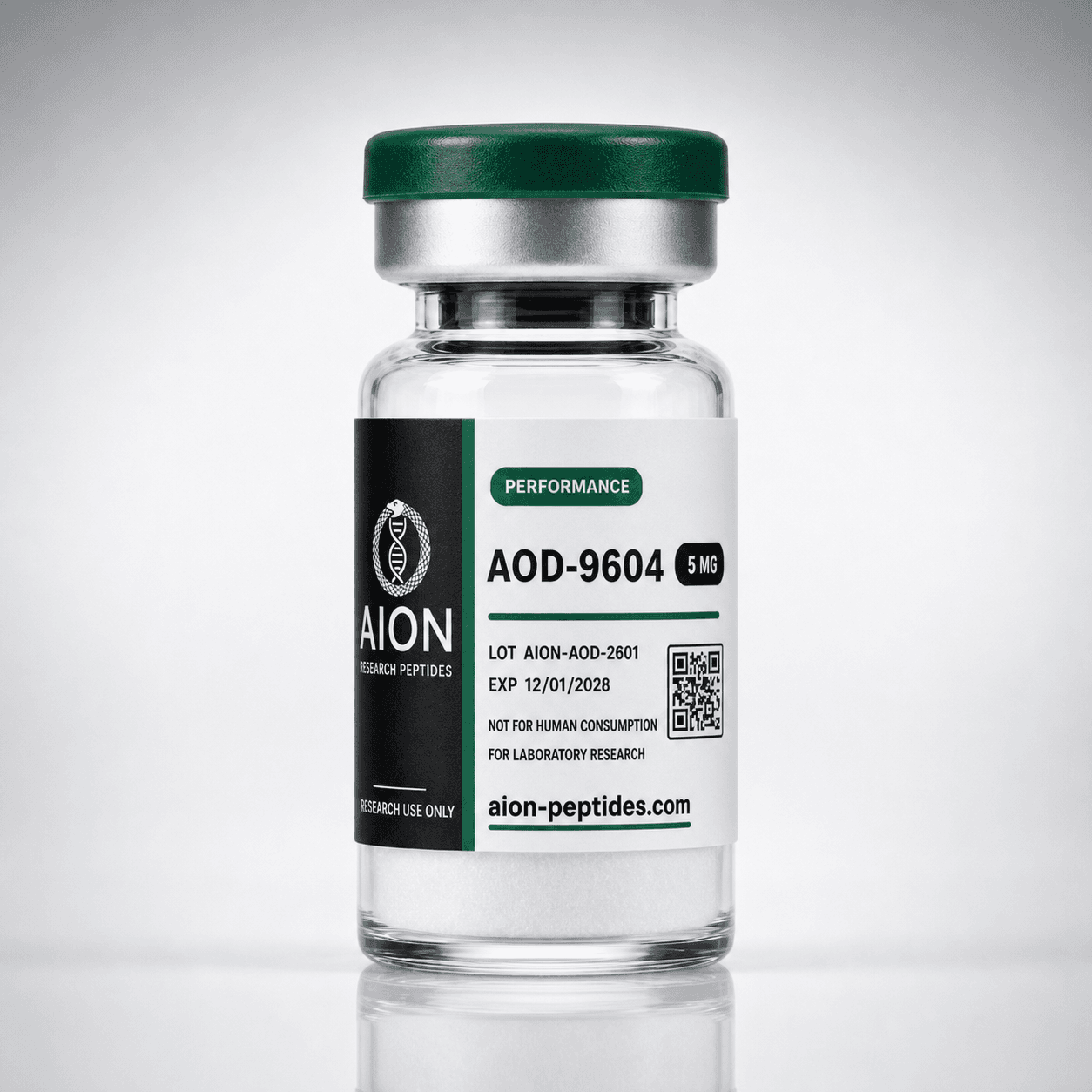
AOD-9604 5mg
AOD-9604 is a modified fragment of human growth hormone — the C-terminal residues 177–191, with a tyrosine added at the N-terminus to improve stability. It carries the lipolytic region of the parent hormone without its growth-promoting domain, which is why it appears in metabolic and adipose-tissue research rather than in growth studies. Supplied lyophilised. For laboratory research use only.
$79.99
About AOD-9604 in research
AOD-9604 is a synthetic 16-residue peptide derived from the C-terminus of human growth hormone, studied mainly in rodent models of lipid metabolism. It consists of growth hormone residues 177-191 with a tyrosine added at the N-terminus, giving the sequence YLRIVQCRSVEGSCGF with a disulfide bond between its two cysteines. The work behind it began at Monash University, where Wu and Ng reported in 1993 that the synthetic fragment hGH 177-191 reduced lipogenesis in rat adipose tissue to a degree comparable with the intact hormone, while showing no significant lipolytic effect as measured by glycerol release from rat epididymal fat pads.
Most of the published AOD-9604 work comes from the same group and concerns adipose tissue in obese rodents. Heffernan and colleagues reported that in ob/ob mice treated for 30 days, body-weight gain was lower than in saline controls from day 16 onward, with no difference in food consumption. Adipose tissue taken from these animals showed reduced lipogenic and increased lipolytic activity ex vivo, and the treated mice showed an acute rise in energy expenditure and in glucose and fat oxidation. In the same paper, the peptide increased lipolytic activity and decreased lipogenic activity in isolated adipose tissue from obese rodents and from humans. Ng and co-authors reported lower body-weight gain over 19 days in obese Zucker rats, with increased lipolytic activity in adipose tissue and, in euglycaemic clamp studies, no change in insulin sensitivity, in contrast to chronic treatment with intact growth hormone.
A 2001 study examined the role of the beta-3 adrenergic receptor. In obese mice treated for 14 days, both growth hormone and AOD-9604 reduced body weight and adipose tissue mass and raised the repressed expression of beta-3 adrenergic receptor RNA towards lean-mouse levels. In beta-3 receptor knock-out mice, the long-term change in body weight and lipolysis seen in wild-type mice did not occur, yet an acute experiment still showed increased energy expenditure and fat oxidation. The authors concluded that the lipolytic action is not mediated directly through this receptor, although increased receptor expression may contribute to lipolytic sensitivity.
Outside lipid metabolism, a 2015 study in a collagenase-induced knee osteoarthritis model in rabbits reported lower gross morphological and histopathological cartilage degeneration scores in groups given intra-articular AOD-9604, alone or with hyaluronic acid, than in saline controls. Analytical work from an anti-doping laboratory describes the peptide's detection in urine and its breakdown in serum and urine in vitro, where a single fragment, CRSVEGSCG, was markedly more stable than the parent peptide or other metabolites.
The evidence summarised here is preclinical: rodent and rabbit studies, ex vivo adipose tissue and in vitro metabolism work, much of it from a single research group. The mechanisms listed below are proposals drawn from these models rather than an established account.
- Reduced lipogenesis in adipose tissue, reported for the parent fragment hGH 177-191 in rat adipose tissue and for AOD-9604 in adipose tissue from obese mice.
- Increased lipolytic activity in adipose tissue, reported ex vivo in obese mice and rats and in isolated human adipose tissue.
- Restoration of beta-3 adrenergic receptor RNA expression in obese mice, proposed to increase lipolytic sensitivity, although knock-out studies indicate the lipolytic action is not mediated directly through this receptor.
- Acute increases in energy expenditure and fat oxidation, reported in ob/ob mice and in beta-3 receptor knock-out mice.
- Wu Z, Ng FM (1993). Antilipogenic action of synthetic C-terminal sequence 177-191 of human growth hormone. Biochem Mol Biol Int. [RODENT] PubMed record for reference 1, Wu 1993
- Heffernan MA, Jiang WJ, et al. (2000). Effects of oral administration of a synthetic fragment of human growth hormone on lipid metabolism. Am J Physiol Endocrinol Metab. [RODENT] PubMed record for reference 2, Heffernan 2000
- Ng FM, Sun J, et al. (2000). Metabolic studies of a synthetic lipolytic domain (AOD9604) of human growth hormone. Horm Res. [RODENT] PubMed record for reference 3, Ng 2000
- Heffernan M, Summers RJ, et al. (2001). The effects of human GH and its lipolytic fragment (AOD9604) on lipid metabolism following chronic treatment in obese mice and beta(3)-AR knock-out mice. Endocrinology. [RODENT] PubMed record for reference 4, Heffernan 2001
- Kwon DR, Park GY (2015). Effect of Intra-articular Injection of AOD9604 with or without Hyaluronic Acid in Rabbit Osteoarthritis Model. Ann Clin Lab Sci. [OTHER ANIMAL] PubMed record for reference 5, Kwon 2015
- Cox HD, Smeal SJ, et al. (2015). Detection and in vitro metabolism of AOD9604. Drug Test Anal. [IN VITRO] PubMed record for reference 6, Cox 2015
Identity
- SEQUENCE
- YLRIVQCRSVEGSCGF (Tyr-Leu-Arg-Ile-Val-Gln-Cys-Arg-Ser-Val-Glu-Gly-Ser-Cys-Gly-Phe), disulfide Cys7-Cys14
- MOLECULAR FORMULA
- C78H123N23O23S2
- MOLECULAR WEIGHT
- 1815.1 g/mol
- CAS NUMBER
- 221231-10-3
- PUBCHEM CID
- 71300630
From PubChem (CID 71300630) and the published sequence (Cox et al., 2015); no certificate of analysis has been published for this product yet.
Storage and handling
- Keep the lyophilised powder sealed, dry and protected from light, typically at -20 °C for long-term storage. Allow the vial to reach room temperature before opening to limit moisture uptake.
- Once in solution, keep at 2–8 °C and use promptly. For longer storage, solutions are typically divided into aliquots and frozen at -20 °C or below, avoiding repeated freeze-thaw. Solution stability has not been established for this lot.
- Generally soluble in sterile water and common aqueous buffers. Add the solvent slowly down the side of the vial and swirl gently rather than shaking.
- Adding 2.5 mL of sterile water to a 5 mg vial gives a 2 mg/mL stock solution.
Lab testing
Certificate of Analysis
No certificate of analysis is published for this product yet. Where a certificate exists we publish it in full, as issued by the laboratory — the measured purity, the lot number and the date of analysis, not a summary written by us.
Certificates are being obtained for the remainder of the catalogue.
Questions
What is the amino acid sequence of AOD-9604?
YLRIVQCRSVEGSCGF: Tyr-Leu-Arg-Ile-Val-Gln-Cys-Arg-Ser-Val-Glu-Gly-Ser-Cys-Gly-Phe, sixteen residues with a disulfide bond between the two cysteines. PubChem (CID 71300630) gives the formula C78H123N23O23S2 and a molecular weight of 1815.1 g/mol, and lists CAS 221231-10-3.
How does AOD-9604 differ from human growth hormone and from hGH 177-191?
Human growth hormone is a 191-residue protein. hGH 177-191 is a synthetic 15-residue peptide matching its last fifteen residues, studied for its effect on lipogenesis in rat adipose tissue. AOD-9604 is that fragment with a tyrosine added at the N-terminus. In obese Zucker rats, Ng and co-authors reported no change in insulin sensitivity with AOD-9604, in contrast to chronic treatment with intact growth hormone.
How should AOD-9604 be stored in the lab?
As lyophilised powder, sealed, dry and away from light, typically at -20 °C for long-term storage. Once in solution, keep it at 2–8 °C and use it promptly, or freeze aliquots to avoid repeated freeze-thaw.
Is there a certificate of analysis for AOD-9604?
Not yet. No certificate of analysis has been published for this product, and the COA library at /coa lists it as in progress. The identity figures on this page come from PubChem and the published sequence.
In which research models has AOD-9604 been studied?
Mostly in rodents: ob/ob mice, obese Zucker rats and beta-3 adrenergic receptor knock-out mice, with adipose tissue examined ex vivo, including isolated human adipose tissue. Other work includes a collagenase-induced knee osteoarthritis model in rabbits and in vitro metabolism studies in serum and urine.
REVIEWED BY DEL POTTER, PHD · OCT 26, 2026
FOR LABORATORY RESEARCH USE ONLY · NOT FOR HUMAN OR ANIMAL USE · MUST BE 21+